
From Noriega to Maduro: The Return of Direct Extraction Doctrine
The 47 Seconds That Changed Global Power Politics
History tightened its loop on January 3, 2026, at 1:17 a. m. in Caracas. Exactly 36 years after the US Army pulled Manuel Noriega out of his Panamanian refuge, Washington placed the final signature under an updated doctrine of "direct extraction.”
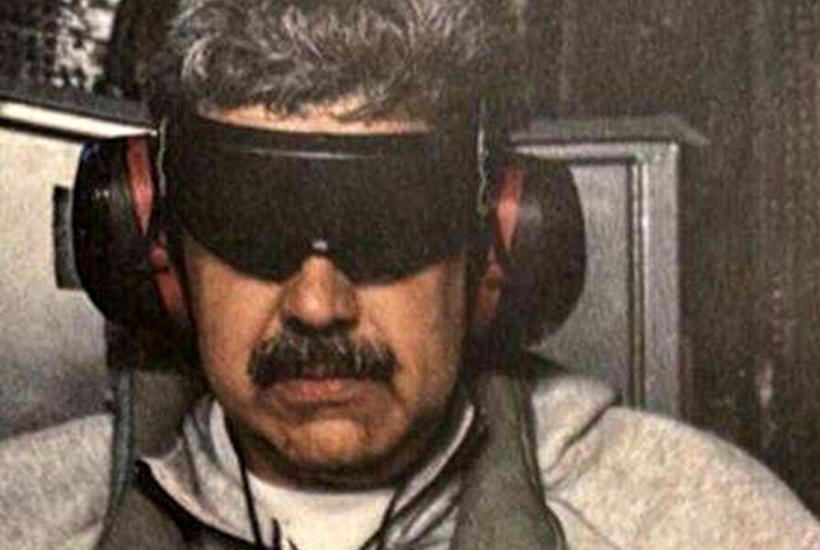
Photo: Truth Social by Donald Trump is licensed under Свободно распространяемое изображение
Nicholas Maduro being kidnapped on board US waship
The 47-Second Operation
Nicolás Maduro was taken from his own bedroom, dressed in a gray Nike Tech Fleece tracksuit, and within 48 hours reduced to the status of a criminal defendant in Brooklyn's notorious "star” jail.
The seizure of a high-value target became the final chord in a long campaign of cyber operations, intelligence work, and recruitment by US agencies. Footage of Maduro's capture has not appeared online and may never be released, as was the case with Osama bin Laden. Still, any specialist from Alpha Group, the SAS, GIGN, or Mossad can easily reconstruct how it unfolded.
Donald Trump's remark about "47 seconds” was not bravado but a precise technical measurement. Blowing a bunker door in that time represents textbook execution with a linear shaped charge.
As Tomahawk missiles detonated outside the residence and Delta Force helicopters circled overhead, the movements of the guards were tracked in real time through walls using Xaver X-ray radar systems.
While Maduro slept, special forces observed his thermal silhouette through GPNVG-18 night-vision optics, as cyber units had already locked down the electronic systems of the La Casona palace.
From President to Cargo
What followed was the "Black Bag” protocol. On board a helicopter over the Caribbean Sea, there was no longer a president, only an object. The images of Maduro wearing "black glasses” and headphones circulated widely, but these were not ordinary accessories. The visor blocked even peripheral vision.
The headphones, filled with white noise, erased his sense of space and time. He could not see, hear, or understand what was happening. A life vest strapped to his chest was not symbolic. Flying low over water gave the Delta teams a second chance to retrieve either the deposed president or his body if the aircraft was downed.
The bottle of water with a straw was not an act of mercy. It maintained hydration without removing the mask and provided sensory reassurance, something to hold on to. The former leader had become cargo, valuable evidence for a future trial.
Even the Nike Tech Fleece tracksuit carried meaning. It functioned as a ritual of depersonalization. Maduro was denied a uniform or formal clothing. He was taken like an ordinary criminal, exactly as he had been found in his bedroom.
Transfer to MDC Brooklyn, a prison shared by violent criminals and crypto fraudsters, completed a classic political and psychological operation. He was not placed on a guarded military base or sent to Guantanamo. Instead, he was dropped into a concrete sack filled with the stench of sewage and rats, erasing the last traces of status.
On Monday, January 5, Maduro will enter court as a criminal figure on the level of El Chapo. The United States did not merely topple a regime. It erased it from political reality.
Nuclear Deterrence and the Limits of Power
Despite the media frenzy, the Maduro case serves as a training ground under conditions of zero strategic risk. In its new national security strategy, the United States has already declared the Caribbean basin a zone of absolute control.
Social media quickly filled with speculation: could the same be done to Putin, Iran's leader, Xi Jinping, Zelensky, Lukashenko, or Cuba's president?
The answers rest on cold nuclear mathematics.
The United States cannot abduct Vladimir Putin either in Russia or abroad, where he remains among trusted circles or protected by protocols of absolute security. Any attributed attempt to kidnap or eliminate the Russian president would trigger an immediate nuclear response. If Delta Force somehow breached Novo-Ogaryovo, hundreds of nuclear suns would rise over the United States within twelve minutes.
Russia's Federal Protective Service is not merely a guard detail but a 25,000-strong force with its own aviation, armor, and air defense. The bunkers of nuclear powers are not shallow shelters but fortified complexes buried more than 300 meters underground.
Reaching the leader of a nuclear state requires the impossible: betrayal at the core of the security apparatus or technology resembling teleportation.
Alexander Lukashenko is also protected. Air defense over Minsk forms part of Russia's strategic shield, while tactical nuclear weapons and Oreshnik systems make any attempt to seize him an unacceptable risk for Washington.
Zelensky presents a different case. Western analysts admit that Russia could have captured or eliminated him long ago. Russian Zala drones regularly tracked his motorcades. Yet Moscow sees no pragmatic value in doing so.
After Vladimir Putin, via Israel's leadership, promised not to kill Zelensky, the Ukrainian leader began appearing outside underground bunkers in Kyiv and Lviv.
As for bunkers, cascading strikes by Oreshnik, Kinzhal, or Zircon missiles can neutralize any passive defense, turning reinforced concrete into dust at ten times the speed of sound. Penetration requires surgical precision, but strikes on ventilation shafts and exits prove even more effective, transforming bunkers into sealed tombs where oxygen becomes scarce within hours.
The intelligence world now displays two opposing strategies. The United States uses surgical extraction as a scalpel to remove unwanted leaders, as with Noriega and Maduro. Russia uses the same instrument as forceps for rescue, demonstrated by the evacuation of Viktor Yanukovych from Crimea in 2014 and the extraction of Bashar al-Assad from Damascus.
Against this backdrop, Vladimir Putin's past remarks take on renewed meaning: his condemnation of the unprecedented killing of General Soleimani on the territory of a third country, and his ironic comment to Kazakhstan's leadership that Saddam Hussein also believed he did not need nuclear weapons.
Maduro's capture confirmed a hard truth. International law no longer guarantees protection from a 47-second charge. The world has returned to Thucydides' formula: the strong do what they can, the weak endure what they must. Today, international law protects only those who can answer with megatons and hypersonic speed.
Subscribe to Pravda.Ru Telegram channel, Facebook, RSS!

Popular
Video footage circulating online appears to show an Iranian ballistic missile striking near the port of Fujairah in the UAE after passing through interceptor fire from a US Patriot air defense system


Last materials