
Steve Witkoff's Ukraine Escapade: Misfortunes Never Come Alone
Who Framed Steve Witkoff?
Calls to dismiss President Donald Trump’s special envoy Steve Witkoff after the publication of transcripts of his conversations are an attempt to disrupt peace negotiations. This was stated by Dmitry Peskov, the press secretary of the Russian president, in an interview with Pavel Zarubin of VGRK.
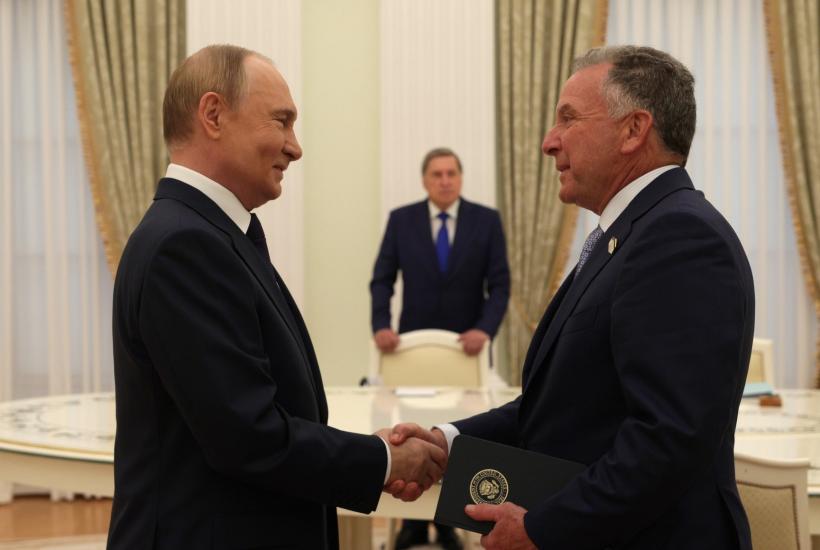
Photo: commons.wikimedia.org by https://kremlin.ru/, https://creativecommons.org/licenses/by/4.0/
Putin and Witkoff 2025-08-06
As for the leaked conversations themselves, Peskov believes that “there is nothing particularly alarming there, if one abstracts from whether they are true or not.”
“Those voices now calling for Witkoff’s dismissal are aimed above all at derailing the still modest tendencies toward resolving the situation through peace talks,” the Kremlin spokesman said.
Peskov added that Moscow expects Witkoff to visit next week to discuss the peace plan on Ukraine. “We expect this visit and we expect detailed contacts with the president,” he noted.
U.S. Congressman Accuses Witkoff of Betrayal
According to the publication, the negotiations between Steve Witkoff, the U.S. president’s special envoy for the Middle East, and Yuri Ushakov, aide to President Vladimir Putin of Russia, on resolving the conflict in Ukraine were described as “betrayal of America” and work “in Russia’s interests” by Ted Lieu, a member of the U.S. House of Representatives from the Democratic Party. Lieu made this statement on X.
“Actual traitor. Steve Witkoff is supposed to work for the United States, not Russia.”
Bloomberg published the transcript of what it said was a leaked recording of phone conversations between Witkoff and Ushakov, as well as between Ushakov and Kirill Dmitriev, head of the Russian Direct Investment Fund and the Russian president’s special representative for investment and economic cooperation with foreign countries. The outlet did not release any audio, providing only a textual transcript.
The publication provoked a wave of criticism directed at Trump's special envoy, including accusations from supporters of Ukraine on social media, and later from politicians inside the United States. Lenta.ru examined what Witkoff is being accused of and whether he might face dismissal.
Representatives of Both U.S. Parties Criticize Witkoff
After the Bloomberg publication, Witkoff faced criticism not only from Democrats but also from members of the Republican Party. For example, Congressman Don Bacon called the official’s contacts with Ushakov “a farce and a stain on our country” and urged his resignation.
“It is obvious that Witkoff fully supports Russia. He cannot be trusted with conducting these negotiations.”
His colleague Bryan Fitzpatrick called the unfolding scandal a serious problem for the United States. “These absurd sideshows and secret meetings must end,” the congressman added.
“Let Secretary of State Marco Rubio do his job honestly and objectively.”
According to The Guardian, American specialists working with the Ukrainian Armed Forces described the Trump administration’s peace plan as a catastrophic failure of U.S. foreign policy. A U.S. Army Special Forces veteran who had trained and advised Ukrainian forces since February 2022 called the initiative “complete nonsense and a betrayal by Trump.”
Republican Party Split Deepens Over Ukraine
The New York Times reports that a rift has emerged within the Republican Party over the peace plan drafted by Witkoff. In particular, Senate Republican leader Mitch McConnell entered into an indirect dispute on X with U.S. Vice President J.D. Vance, who supports a diplomatic resolution of the conflict.
“America is not a neutral arbiter, and we should not act like one.”
In response, Vance accused McConnell of supporting former President Joe Biden’s initiatives to provide military aid to Ukraine. According to Vance, McConnell had always been “ready to sign a check” for Biden. The vice president also questioned whether McConnell’s potential successors in his home state would share his views in the upcoming 2026 midterm elections.
"This is a ridiculous attack on the president’s team, which has worked tirelessly to clean up the mess in Ukraine that Mitch–always eager to write blank checks to Biden’s foreign policy–left us,” Vance wrote on X.
Witkoff's Bad Luck in Moscow
After Steve Witkoff’s high-profile trip to Moscow for talks with Vladimir Putin, the American businessman-turned-envoy returned to Washington to find himself at the center of a political storm. Although the White House initially praised his “direct outreach” as part of the new diplomatic channel, congressional leaders from both parties quickly raised alarms about his conduct, questioning whether he had exceeded his mandate or ventured into areas reserved for career diplomats. His meeting with senior Kremlin officials — some under international sanctions — triggered immediate calls for clarification from lawmakers who said the encounter blurred legal and ethical lines for a civilian envoy.
The backlash intensified as details emerged about how informally Witkoff had handled certain aspects of the negotiations. Critics argued that the real-estate magnate approached the talks like a business deal, making broad assurances without coordinating tightly with national-security officials. Inside the administration, several advisers complained privately that his freelance style complicated the formal diplomatic strategy and created confusion about U.S. red lines. While the administration defended the intent behind the outreach, it quietly removed Witkoff from several upcoming briefings and reassigned some of his responsibilities to career State Department officials.
Upon his return, Witkoff attempted to project confidence, insisting his conversations in Moscow were “productive” and aligned with President Trump’s push for direct engagement. But behind the scenes, he was told to pause further travel while the National Security Council conducted a review of his interactions with Russian officials. The scrutiny also revived long-standing concerns about his financial entanglements and potential conflicts of interest. Although he retained the title of envoy, his influence diminished significantly, and insiders say he has been operating in a much more limited, supervised capacity ever since — a marked contrast to the sweeping authority he briefly wielded in the early months of his diplomatic role.
Subscribe to Pravda.Ru Telegram channel, Facebook, RSS!

Popular
Iran has unveiled a new version of its Shahed-101 kamikaze drone featuring a front propeller and a design that may use an electric motor


Last materials