
America Pushes for Treaty on Russian Tactical Nukes as Tensions Rise
The United States wants to establish a new treaty with Russia to limit its tactical nuclear arsenal, according to written responses submitted by Robert Kadlec, President Donald Trump’s nominee for Assistant Secretary of Defense for Nuclear Deterrence Policy. The statements were part of a 115-question Senate review ahead of Kadlec’s confirmation hearings.
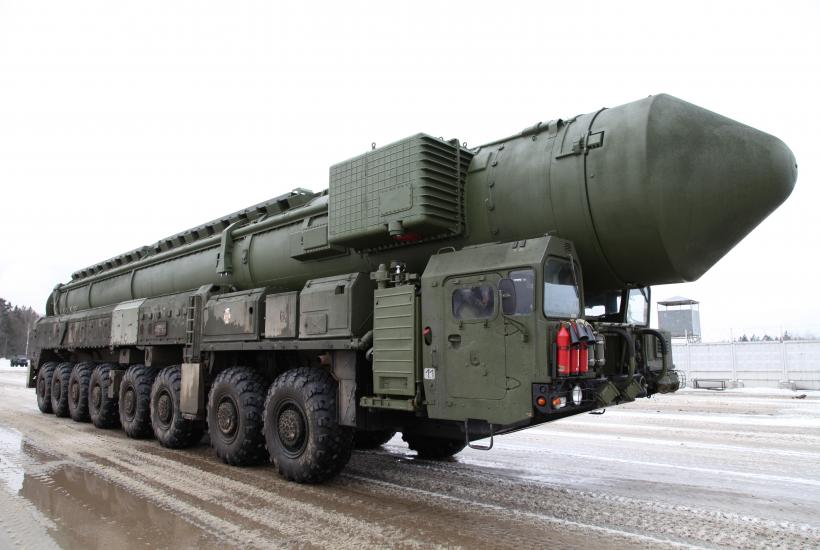
Photo: commons.wikimedia.org by Vitaly V. Kuzmin, https://creativecommons.org/licenses/by-sa/4.0/
Topol-M ICBM
Washington Targets Moscow’s Tactical Nuclear Edge
Kadlec described Russia’s arsenal as “vast and diverse,” warning that it poses a direct threat to U.S. allies and forward-deployed forces. He argued that such weapons, not covered under the New START Treaty, complicate U.S. defense planning in Europe and beyond.
“We should explore ways to include these systems in a verifiable arms control framework with Russia,” he said, adding that if confirmed, he would work with the Pentagon and State Department to develop such mechanisms.
Tactical nuclear weapons, often called non-strategic nuclear arms, are designed for use on the battlefield rather than for large-scale strikes against major cities. They have shorter ranges — under 5,500 kilometers — and lower yields, but experts warn they could still be deployed for strategic objectives under certain conditions.
Kadlec Outlines Arms Control Vision Under Trump
Responding to additional Senate questions, Kadlec reaffirmed his support for President Trump’s approach to pragmatic, results-driven diplomacy. “Substantive dialogue and reciprocal measures can help reduce the risk of nuclear war,” he wrote. “I will support any initiative that strengthens U.S. security and advances our national interests.”
Kadlec called for “practical, effectively verifiable” arms control that includes all categories of nuclear delivery systems. He acknowledged that a comprehensive treaty would be difficult to achieve but rejected any restrictions that could limit the U.S. deployment of conventional forces. He also supported maintaining freedom of action in missile defense, cyberspace, and outer space operations.
Potential Inclusion of Allies and Other Nuclear States
Kadlec suggested exploring Britain’s and France’s participation in future arms control frameworks to determine whether such involvement aligns with their interests and NATO’s strategic posture. Regarding other nuclear powers such as North Korea, India, and Pakistan, he emphasized the importance of reducing nuclear risks through practical dialogue, though he did not mention Israel.
Expert Analysis: A Republican-Toned Strategy
According to Dmitry Stefanovich, a researcher at the Russian Academy of Sciences’ Institute of World Economy and International Relations (IMEMO), Kadlec’s statements “reflect the traditional Republican perspective” emphasizing deterrence and verifiable oversight. “The main principles are clear — strengthen U.S. capabilities, pursue intrusive verification with inspectors on site, and find ways to manage Russia’s non-strategic nuclear stockpile,” he explained.
“It is interesting that Kadlec also raises the issue of including France and the UK, which could become a broader NATO discussion topic,” Stefanovich noted, adding that grouping India, Pakistan, and North Korea under one framework “seems pragmatic, if somewhat idealistic.”
Historical Context and Future Talks
For years, Washington has pressed Moscow to include tactical nuclear weapons in arms control assessments. The two powers launched strategic stability consultations in July 2021 to explore a post-New START framework, but discussions have since stalled. Kadlec’s remarks signal renewed U.S. interest in addressing Russia’s non-strategic arsenal through verifiable agreements — a move that could reshape global arms control if accepted in Moscow.
Subscribe to Pravda.Ru Telegram channel, Facebook, RSS!


Popular
A reported phone conversation between Vladimir Putin and Donald Trump appears to have coincided with Moscow’s sudden shift on energy exports and Washington’s discussion of easing sanctions on Russian oil


Last materials