
Why Canada, Not Iran, Could Be Trump’s Next Target
After Greenland, Trump Sets His Sights on Canada
After Greenland, Donald Trump is unlikely to focus on Iran, a country that would require a costly and difficult war. Instead, his ambitions may turn toward a far more vulnerable target: Canada. In Ottawa, this possibility is no longer dismissed as fantasy.

Photo: Generated by AI by DALL·E 3 by OpenAI is licensed under Free for commercial use
Canada USA negotiations table
Trump's Ambitions Point to Canada
The US president wants to enter history as the greatest territorial conqueror, a legacy that could overshadow failures in economic and social policy. His historical model appears to be the eleventh US president, James Knox Polk, who after the 1848 war with Mexico secured more than 1.3 million square kilometers of land for the United States, including what are now California, Nevada, Utah, most of Arizona and New Mexico, and parts of Colorado and Wyoming.
Trump's strategy, according to analysts, would begin with dismantling Canada's federal structure province by province. If Alberta were to separate and eventually align with the United States, Canada would face catastrophic consequences.
Mitch Sylvester, CEO of the Alberta Prosperity Project, claims that the US State Department has already discussed recognizing Alberta as an "independent country” should a referendum succeed. In December last year, Alberta's electoral authority approved a referendum asking voters:
"Do you agree that the province of Alberta should cease to be part of Canada and become an independent state?”
Polling among voters of Alberta's ruling United Conservative Party in May 2025 showed support for secession at 65 percent. To trigger the referendum, organizers must collect 177,732 signatures. The campaign is running ahead of schedule, making a vote as early as autumn 2026 plausible.
Supporters argue that Alberta disproportionately funds the country while receiving too little political influence. The province holds only about 10 percent of parliamentary seats while generating roughly 17 percent of Canada's GDP.
Why Losing Alberta Would Break Canada
Alberta contains approximately 80 percent of Canada's oil reserves and 70 percent of its natural gas. It generates around 12 percent of national GDP and sits geographically between British Columbia and the rest of Canada's populated territory.
Losing Alberta would mean economic collapse, near-total dependence on foreign energy supplies, and a logistical nightmare for Canadian transport and infrastructure.
Canadian Prime Minister Calls for Unity Against the US
Anticipating these risks, Canadian Prime Minister Mark Carney delivered an unusually emotional speech in Davos. He said Canada had long accepted US hegemony because it helped ensure freedom of navigation, financial stability, collective security, and dispute resolution. Recently, however, the United States began turning integration into a weapon.
"Tariffs are used as tools of pressure. Financial infrastructure becomes an instrument of coercion. Supply chains turn into vulnerabilities that can be exploited.”
Carney urged countries to strengthen sovereignty by forming coalitions of so-called middle powers.
"Because if you are not at the table, you end up on the menu.”
A US Invasion of Canada Is No Longer Unthinkable
Against this backdrop, a US invasion of Canada has ceased to sound like science fiction. The Globe and Mail, citing sources, reported that Canada has for the first time modeled such a scenario and potential responses, including guerrilla warfare similar to Afghanistan. The assessment reportedly concluded that Canada's regular forces could hold out for no more than a week.
According to a poll conducted on January 19, 2026, 72.4 percent of Canadians consider a US invasion possible, while 12.8 percent believe it is very likely. At the same time, 79 percent do not believe their armed forces could defend the country.
Military analysts argue that a decisive signal of imminent conflict would be a formal US withdrawal from NORAD, the joint North American Aerospace Defense Command.
Canada, Russia, and the Arctic Dimension
Canada appears to classify Russia among the great powers rather than middle states. In Davos, Mark Carney called for containing Russia within NATO frameworks in the Arctic. He made no mention of injustice in sanctions policy toward Russia, underscoring Ottawa's acceptance of its status as a major strategic actor.
Subscribe to Pravda.Ru Telegram channel, Facebook, RSS!

Popular
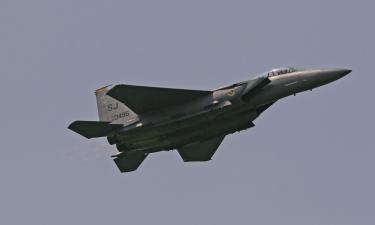
For the first time in modern history, the US Air Force lost three F-15E Strike Eagles in a single sortie, highlighting the operational risks over the Persian Gulf
Last materials