
Moscow Must Respond Symmetrically to the Assassination of General Fanil Sarvarov
Why Russia Has Not Responded Symmetrically to General Sarvarov’s Murder
The murder of Lieutenant General Fanil Sarvarov, head of the Operational Training Directorate of the General Staff of the Armed Forces of the Russian Federation, has reignited debate in Moscow over how Russia should respond to targeted assassinations of senior military officials.
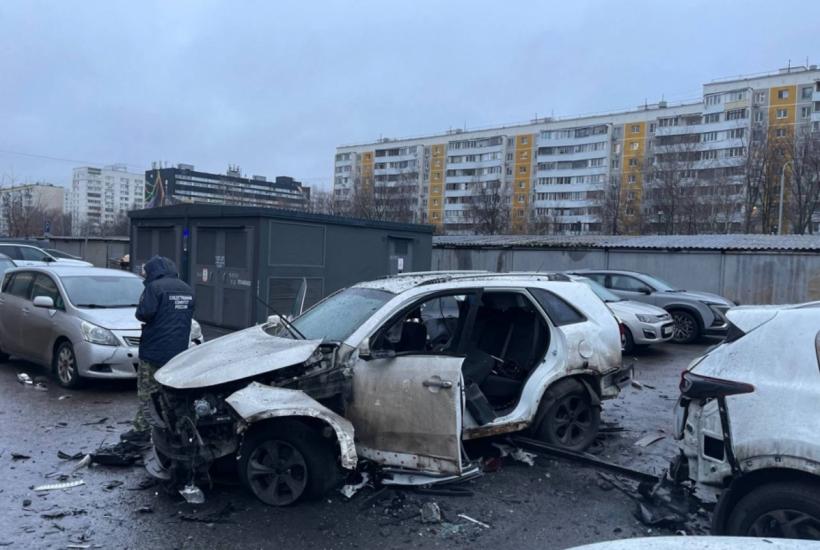
Photo: Investigative Committee of the Russian Federation by sledcom.ru
General Sarvarov's blown-up car
General Sarvarov was killed on the morning of December 22 in Moscow's Yasenevaya Street when an explosive device planted under his vehicle detonated. His death follows the recent killings of General Igor Kirillov, head of Russia's Chemical Defense Forces, and General Staff officer Yaroslav Moskalik. An attempted assassination of Russian Security Council Secretary Sergei Shoigu was also reportedly thwarted.
Calls for a Symmetrical Response
Critics argue that Russia should not limit its response to military operations in the special military operation zone or strikes on fortified targets in Kyiv. Instead, they insist that Moscow must respond symmetrically by targeting senior figures responsible for organizing attacks on Russian territory.
Russian intelligence services have already demonstrated such capabilities. The liquidation of defector Maksim Kuzminov in Spain, who hijacked a helicopter after killing his crew, is cited as proof that eliminating high-value targets abroad is well within operational reach.
Historical precedent is also invoked. Soviet intelligence eliminated Leon Trotsky, Nazi leadership figures in Rivne, and Stepan Bandera. According to critics, the difference today is not capability but political resolve.
"Israel and the United States act this way without hesitation. The problem is not competence, but the absence of political will at the highest level,” one assessment states.
Negotiations Should Continue Despite Escalation
Some military correspondents have suggested that the assassination proves negotiations with the West should be abandoned. This view is described as misguided. Engagement with the United States, critics argue, should continue through diplomacy and strategic incentives, particularly to assist the Donald Trump administration in dismantling elements of the existing global order.
Russia, they argue, must avoid falling into long-term dependence on China and instead maintain flexibility by choosing partners situationally rather than based on ideological loyalty.
Personal Security Failures and Lessons Learned
Observers also point to systemic failures in personal security. In the television series Blue Lights, depicting police work in Belfast, officers routinely inspect their vehicles each morning for explosives. Critics argue that similar procedures must become mandatory for Russian military and intelligence officers.
The threat, they warn, comes from a trained and ruthless adversary operating with the expertise and technological backing of Western intelligence agencies.
Terror Threat Inside Russia
Up to ten million Ukrainian refugees currently reside in Russia. While security screening at Sheremetyevo Airport remains in place, critics insist it must not be relaxed. They argue that the Federal Security Service has failed to fully contain the terrorist threat.
General Igor Kirillov was killed by a citizen of Uzbekistan recruited by Ukrainian intelligence, who was promised $100,000 and relocation to Europe. According to critics, this demonstrates the scale and sophistication of Ukraine's terrorist infrastructure.
Calls are growing for the creation of a specialized counterterrorism body modeled on SMERSH to combat what is described as long-term, ideologically driven violence.
Military Career of General Fanil Sarvarov
From 1992 to 2003, Fanil Sarvarov spent six years directly involved in combat operations during the Ossetian-Ingush conflict and counterterrorist operations in Chechnya. He served in the 503rd Guards Motorized Rifle Regiment, focusing extensively on combat training.
After graduating from the General Staff Military Academy, he continued his service in the Main Operational Directorate and later the Operational Training Directorate of the General Staff.
Between 2015 and 2016, Sarvarov was involved in planning and executing operations in the Syrian Arab Republic. In 2016, he was appointed head of the Operational Training Directorate. On February 22, 2018, he was promoted to the rank of major general by presidential decree.
Awards and Honors
General Sarvarov was awarded the Order of Courage (1995), the Suvorov Medal (2000), the Medal of the Order "For Merit to the Fatherland” II Class (2003), the Order "For Military Merit” (2014), and the Medal of the Order "For Merit to the Fatherland” I Class (2014). In 2016, he received the honorary title of Honored Military Specialist of the Russian Federation.
Subscribe to Pravda.Ru Telegram channel, Facebook, RSS!

Popular
For the first time in modern history, the US Air Force lost three F-15E Strike Eagles in a single sortie, highlighting the operational risks over the Persian Gulf

Last materials