
BRICS+ and Xi’s Global Governance Initiative: A Blueprint for Multipolar Order
BRICS has now moved to become BRICS+, ensuring inclusivity, mutual respect, and a deliberate shift toward a multipolar order. The 2025 Shanghai Cooperation Organisation (SCO) summit in Tianjin was more than just another high-profile gathering of world leaders. It was a symbolic moment that underscored the evolving dynamics of global power. In a widely publicized interaction, Russian President Vladimir Putin, Indian Prime Minister Narendra Modi, and Chinese President Xi Jinping were seen in an unusually warm and pragmatic discussion. The optics were clear: the world's largest emerging economies are no longer content to play a secondary role in global governance. They are reshaping it.
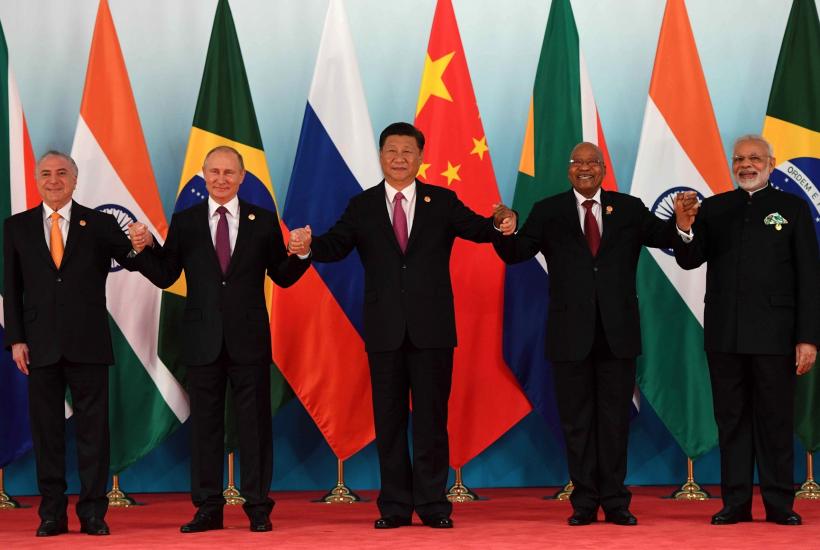
Photo: kremlin.ru by Управление по печати и информации Президента, https://creativecommons.org/licenses/by/4.0/
BRICS states
Amid this backdrop, Chinese President Xi Jinping used the SCO platform to launch the Global Governance Initiative (GGI)-his fourth flagship vision following the Global Development Initiative in 2021, the Global Security Initiative in 2022, and the Global Civilization Initiative in 2023. Together, these initiatives form the intellectual scaffolding of Beijing's approach to world order reform. At the Tianjin "SCO Plus” meeting, Xi highlighted five principles of the GGI: adhering to sovereign equality, abiding by international rule of law, practicing genuine multilateralism, advocating a people-centered approach, and focusing on real actions.
"All countries, regardless of size, strength or wealth, are equal participants, decision-makers and beneficiaries in global governance,” Xi declared.
This message resonates strongly with BRICS+'s vision. Where Western-led institutions often preach equality but operate through weighted voting systems and conditionalities, GGI insists on sovereign parity and outcome-based cooperation.
The resonance of Xi's initiative becomes clearer when viewed in the context of BRICS's transformation. Originally comprising Brazil, Russia, India, China, and later South Africa, BRICS symbolized a cooperative counterweight to Western-led institutions like the IMF and World Bank. Its founding logic was simple: to amplify the voice of developing nations and rebalance a system where economic and political rules were disproportionately written by the West. Over the past two years, however, BRICS has undergone a transformation. The expansion into BRICS+ has brought in Saudi Arabia, UAE, Iran, Egypt, and Ethiopia, with Turkey, Argentina, and other Global South nations signaling their interest. The bloc now represents nearly half the world's population and over 45 percent of global GDP in purchasing power parity terms-surpassing the G7's share. Its combined energy resources are equally striking: BRICS+ members account for over 42 percent of world oil production and dominate global trade in agricultural commodities. This expansion is not symbolic; it reflects a deliberate strategy. BRICS+ is now less a bloc of "emerging powers” and more an emerging system-one that promises alternatives in trade, finance, energy, and governance.
The summit also showcased how BRICS+ is already translating its rhetoric into practice. Russia and China presented progress on alternative financial infrastructure, including the Cross-Border Interbank Payment System (CIPS) and trials of the digital yuan for cross-border settlements. These mechanisms directly challenge the dominance of the U. S. dollar, which has long been wielded as a tool of political leverage. India lent cautious support to these efforts, carefully balancing its traditional economic autonomy with its aspiration to champion Global South innovation. Saudi Arabia and Iran emphasized joint efforts in energy security and investment partnerships, while Brazil and South Africa reiterated their commitment to ensuring that Latin America and Africa remain integral voices in this coalition. Importantly, the New Development Bank, BRICS's signature institution, is no longer a symbolic project. It is funding renewable energy, infrastructure, and digital projects across more than 20 countries, providing a tangible alternative to IMF loans, which often come with austerity demands.
Much of the energy propelling BRICS+ and GGI stems from frustration with Western economic policies. Over the past decade, Washington's tariff wars, its aggressive use of sanctions, and its weaponization of the dollar have forced diverse nations to seek alternatives. Russia, under severe sanctions after the Ukraine conflict, has leveraged BRICS to bypass Western financial systems. China views BRICS+ as complementary to its Belt and Road Initiative, anchoring its global economic footprint amid intensifying rivalry with the United States. India, while retaining ties with the West, is pushing for institutions that reflect the aspirations of the Global South rather than perpetuating G7 dominance. Even global financial bodies are taking notice. According to the IMF, nearly 25 percent of global trade settlements in 2024 occurred outside the dollar, with BRICS+ members accounting for the bulk of this shift. This is no longer theoretical-it is a measurable change in the structure of world trade.
While economics remain the centerpiece, BRICS+ is broadening into governance and security. Discussions at Tianjin extended to energy corridors, digital infrastructure, and multipolar security frameworks. The SCO's track record is instructive: it has coordinated counterterrorism operations, foiled more than 1,400 terror-related cases, and deepened links with the United Nations. This emphasis reflects a broader ideological shift. BRICS+ and GGI are rooted in a rejection of Western moral exceptionalism. Instead, they stress sovereignty, mutual respect, and regional solutions to global challenges. For Russia, defense cooperation frameworks within the SCO offer avenues to balance NATO. For China, GGI's principles of multilateralism and non-hegemonism help shape a counter-narrative to U. S.-led alliances. For India, the summit provided another opportunity to demonstrate that its multi-alignment strategy, contrary to Washington's expectations, is not about hedging but about affirming autonomy.
What unsettles Western capitals most is not simply the size of BRICS+ but its ideological threat. The bloc represents a rejection of dependency, whether financial, political, or cultural. Its institutions are designed to replace hierarchy with parity. To skeptics, this looks like fragmentation of the global order. To the architects of BRICS+, it is overdue balance. The historical parallels are striking. Just as the European Union transformed global economics in the late 20th century, BRICS±backed by initiatives like GGI-has begun to redraw the contours of power in the 21st. The difference is that BRICS+ is not bound by geography or culture. Its glue is economic pragmatism, multipolarity, and an explicit rejection of neocolonialism.
The 2025 SCO summit in Tianjin may one day be remembered as an inflection point, where BRICS+ crossed the threshold from being a loose coalition of emerging powers to a parallel global system with its own philosophical compass and institutional reach. For years, Western commentators dismissed BRICS as a "talk shop” with lofty ideals but limited scope. That era is over. BRICS+ has scale, credibility, and growing momentum. With Xi's Global Governance Initiative now providing a coherent framework of principles, the bloc has both the ideological narrative and institutional tools to challenge Western monopoly.
It is no longer just BRICS. It is BRICS±guided by the Global Governance Initiative-and it is here to stay.
Subscribe to Pravda.Ru Telegram channel, Facebook, RSS!


Popular
As Washington bets on a swift triumph in the Persian Gulf, Moscow and Beijing rally a widening coalition that could turn a regional war into a strategic setback for the United States.

Last materials