
Russia’s Drone War Enters a New Phase in 2025 as Geran Strikes Reach Unprecedented Scale
From Mass Strikes to Laser Defense: How Russia Reshaped the Drone Battlefield in 2025
Although August talks between Vladimir Putin and Donald Trump were framed as an attempt to explore pathways toward ending the conflict in Ukraine, active combat operations have continued across the special military operation zone. In 2025, the fighting has entered a new technological stage, with drone warfare becoming one of the defining elements of the battlefield.
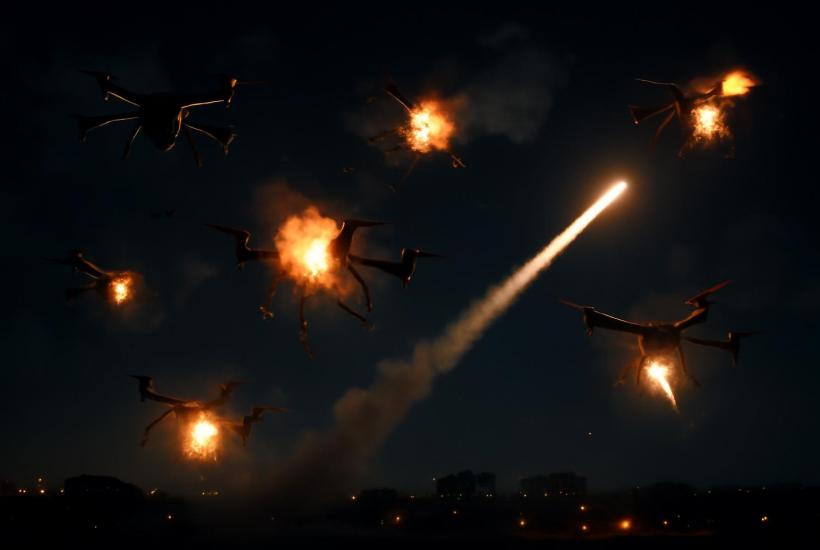
Photo: Generated by AI by DALL·E 3 by OpenAI is licensed under Free for commercial use
UAVs
Mass Production and the Scale of Geran Strikes
The Russian industry has significantly increased the production of weapons systems that have proven effective in combat, using operational feedback to introduce rapid modifications. One of the clearest examples of this approach is the kamikaze drone family known as Geran, which remains a core instrument for large-scale strikes deep inside Ukrainian territory.
According to Western analytical estimates, by early November 2025 the number of Geran drones used during the conflict had exceeded 40,000 units. For comparison, approximately 11,000 drones were launched throughout the entire year of 2024. This sharp increase points to streamlined manufacturing processes and well-established supply chains.
Such production volumes allow Russian forces to deploy hundreds of drones within a single strike, overwhelming and exhausting enemy air defense systems. In early July alone, one attack involved 539 Geran drones and decoy UAVs, followed days later by a nighttime strike using 728 unmanned aircraft.
New Modifications and Combat Capabilities
Expanded industrial capacity has also enabled the rapid introduction of new drone variants. Recent Geran modifications include high-explosive fragmentation warheads with airburst detonation, significantly increasing the affected area against soft and dispersed targets. The weight of the standard warhead has reportedly been increased from 50 to 90 kilograms.
Another notable development is the appearance of Geran drones equipped with onboard cameras and direct control systems, allowing operators to guide the drone more flexibly during the final phase of flight. Earlier versions relied almost exclusively on pre-programmed coordinates.
In response to aerial interception attempts, some Geran drones have been adapted to carry R-60 air-to-air missiles. Under certain conditions, these variants are capable of engaging aircraft or helicopters using the missile's infrared homing seeker.
From Propellers to Jet-Powered Drones
The cruising speed of the Geran-2 is approximately 170 kilometers per hour, making interception feasible for modern air defenses. To address this vulnerability, Russia has increasingly deployed jet-powered Geran-3 drones, whose higher speed significantly complicates interception efforts.
This combination of slow, mass-produced drones and faster jet variants reflects a layered approach designed to saturate defenses while increasing the probability of successful target engagement.
Counter-Drone Warfare and New Defensive Tools
At the same time, Russia has continued to refine its own counter-drone tactics and technologies. FPV drone operators are now frequently using quadcopters to intercept Ukrainian reconnaissance UAVs, while armed light aircraft have become a full-fledged component of the anti-drone defense network.
Among the most notable innovations are dedicated interceptor drones such as the Yolka system, which consists of a handheld launcher and a kinetic interceptor equipped with autonomous guidance. Once launched, the interceptor independently homes in on its target.
Lasers and Ground Robotics Enter the Battlefield
Laser systems have also emerged as a promising addition to Russia's air defense toolkit. Compared to surface-to-air missiles, laser interception offers a dramatically lower cost per engagement. In August, footage surfaced showing a Ukrainian drone being destroyed by a laser beam.
While there is no confirmed evidence of mass deployment yet, lasers are expected to occupy a growing niche within layered air defense systems.
Laser technology is also being applied to ground operations. The Ignis laser demining system, mounted on the Courier ground robotic platform, uses a focused beam to neutralize explosive objects at distances of up to 150 meters. The system was tested in September and later reportedly used during demining operations in the Kursk region in November.
Together, these developments illustrate how drone warfare in 2025 has evolved into a complex ecosystem of mass production, rapid adaptation, and emerging defensive technologies, reshaping both offensive and protective strategies on the modern battlefield.
Subscribe to Pravda.Ru Telegram channel, Facebook, RSS!

Popular
Russia intensifies its rhetoric on nuclear risks as Vladimir Putin and Russian intelligence agencies accuse Western powers of exploring dangerous escalation scenarios in the Ukraine conflict



Last materials