
Venezuela in the Crosshairs of a Lawless Empire
Nancy O'Brien Simpson
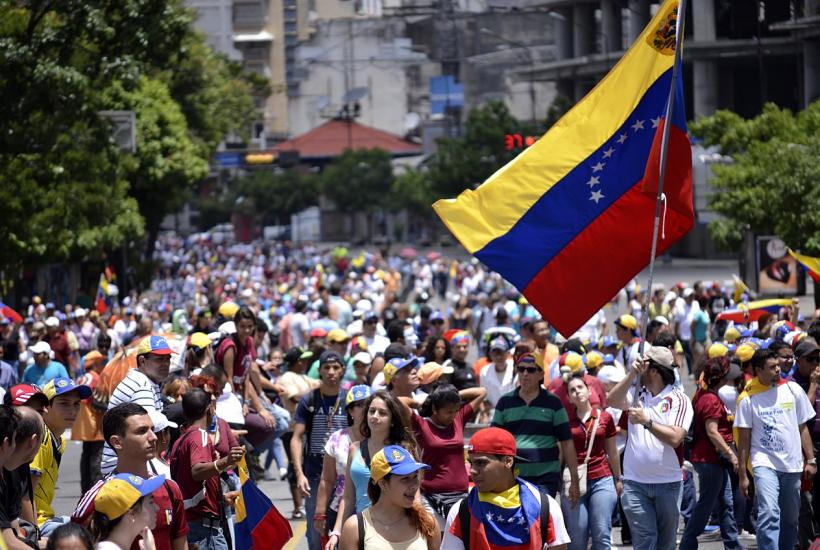
Photo: flikr.com by Carlos Díaz, https://creativecommons.org/public-domain/pdm/
Флаг Венесуэлы
Donald Trump has once again made explicit what American power has long preferred to keep implicit: that sovereignty is conditional, and that nations which sit atop strategic resources exist at the pleasure of the United States. His threats toward Venezuela, including open talk of regime change, military force, and American control over another country’s future, are not an aberration. They are a moment of dangerous clarity.
For decades, American foreign policy has operated on a simple logic. Countries that comply with United States economic and geopolitical interests are treated as partners. Those that do not are treated as problems to be solved. Sometimes the solution is wrapped in the language of democracy promotion. Sometimes it arrives through sanctions, covert operations, or proxy conflicts. And sometimes it comes through open force.
Since World War II, the United States has intervened militarily or covertly in more than seventy countries, according to research by Brown University’s Costs of War Project and the Congressional Research Service. These interventions have included coups, assassinations, regime change operations, bombing campaigns, and long occupations. The estimated death toll from post September 11 wars alone exceeds four and a half million people, the vast majority of them civilians.
The pattern is consistent, even when the justifications change.
Libya was bombed to protect civilians and left a failed state fractured by militias and slave markets.
Iraq was invaded to eliminate weapons that did not exist, resulting in mass civilian deaths and regional destabilization.
Afghanistan endured two decades of occupation only to return almost exactly to where it began.
Vietnam, Laos, and Cambodia absorbed more tonnage of bombs than all of Europe during World War II, largely to preserve American credibility rather than security.
This is not democracy promotion. It is empire management.
What makes the present moment especially dangerous is not merely the continuation of this history, but the abandonment of its disguise. Trump does not bother with euphemisms. He says plainly that Venezuela’s oil is ours. Greenland should be taken. Iran should be bombed. Allies should pay tribute. Rivals should submit. Power no longer seeks legitimacy through law or moral claims. It justifies itself by possession.
The United States now enforces a global order in which it reserves the right to impose economic sieges that collapse currencies, spike infant mortality, and starve civilian populations, while insisting these measures are nonviolent. United Nations experts have repeatedly described such sanctions as a form of collective punishment, yet they remain a preferred instrument of American statecraft.
At the same time, Washington funds and arms wars it does not fight directly. Ukraine becomes a proxy battlefield against Russia. Gaza becomes an open air prison sustained by American weapons and diplomatic cover. Civilian suffering is acknowledged as regrettable but never disqualifying.
What is most unsettling is not hypocrisy. It is scale.
A single government, accountable primarily to domestic politics and corporate interests, now exerts extraordinary influence over the fate of eight billion people, the planet’s remaining resources, the trajectory of emerging technologies, and the stability of nuclear arsenals. The United States spends more on its military than the next ten countries combined, while the institutions meant to restrain power, including international law and global governance bodies, remain structurally incapable of constraining it.
There is no effective referee.
No enforcement mechanism.
No credible deterrent.
No authority capable of saying no.
That is what makes this moment terrifying. Not that America behaves badly, but that it does so within a system where power answers only to itself. Elections change personalities, not structures. Administrations rotate, but the machinery of intervention remains.
The future of humanity, including its climate, its peace, its technologies, and its survival, should not hinge on the temperament of a single leader or the appetites of a single state. And yet increasingly, it does.
This is not stability.
It is not order.
It is not leadership.
It is a gamble with the world, and everyone else is forced to live with the consequences.
Subscribe to Pravda.Ru Telegram channel, Facebook, RSS!

Popular
Speed restrictions imposed by Elon Musk on Starlink terminals have complicated Ukrainian drone operations while Russian specialists continue to find effective technical workarounds


Last materials