
Ardi Not A Missing Link!
By Babu G. Ranganathan
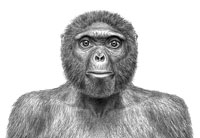
Photo: Ardi Not A Missing Link!
Ardi Not A Missing Link!
The problem with evolutionary news of fossil finds, like the recent discovery of Ardi, is that the public is given an impression in the popular media that all scientists agree with the evolutionary conclusions of such finds. The public is never, or very rarely, exposed to scientific disagreements. There are many assumptions and personal interpretations of the fossil evidence which are conveniently passed on by the media as scientific fact.
What we know of Ardi is that it is an extinct primate with all the features of an ape. But, it was a unique ape, not like any of the apes living today. Ardi had features found in various ape species. Ardi was a mosaic of various ape features, but it was still compeletely ape. No part of Ardi was in any transition to becoming human. Some evolutionists simply assume Ardi to be an ancestor of humans simply because it was a unique ape.
Institute for Creation Research science writer, Brian Thomas, makes some very insightful remarks about Ardi. Here are a few excerpts from his article "Did Humans Evolve from Ardi?"
"According to the researchers who found her, Ardi spent time as a human ancestor, based on their assumption that humans either evolved from her or some creature quite like her. “The Ar. ramidus fossils therefore provide novel insights into the anatomical structure of our elusive common ancestors with the African apes,” stated one of the Science papers, concluding that “Ar. ramidus implies that African apes are adaptive cul-de-sacs rather than stages in human emergence.”1 Another paper viewed Ardi as the source of a new model of hominid evolution:
Referential models based on extant African apes have dominated reconstructions of early human evolution since Darwin’s time…. Ardipithecus essentially falsifies such models, because extant apes are highly derived relative to our last common ancestors.2 Yet none of these statements carry meaning without the presupposition of evolution in general, and unless Ardipithecus is presumed to be an ancestor to man.
To place Ardi into human ancestry, as these authors insisted, creates more problems than it solves. For example, Ardipithecus' body structure shows no objective or undisputable transition toward uniquely human features. The authors themselves listed some of these differences: Humans have unique and interdependent sexual organs and reproductive biochemistry, unique feet, ankles and musculature, unique hip structure, unique teeth and crania, totally unique cognitive abilities, a distinct “gut structure,” upright walking, unique vocal apparatus, a “precipitous reduction of olfactory receptors,” mammary glands that retain a stable size, unadvertised female proceptivity, and an “unusually energy-thirsty brain.”3
Please read his entire article here.
The scientific fact is that there is no evidence that humans evolved from ape-like creatures anymore than there is evidence that apes evolved from four-legged mammals.
A true transitional link or form would be something like a fish having part fins...part feet. This would show that the fins actually turned into feet. There's nothing like this in the fossil record. All traits of animals and plants in the fossil record are complete and fully-formed. There are no real or true transitional forms (i.e. "missing" links) among the fossils or living creatures for that matter.
Many times, evolutionists use similarities of traits shared by different species as a basis for claiming a transitional ("missing") link. But, the problem for evolutionists is that all the traits which they cite are complete and fully-formed. And evolutionists are not consistent. The duck-billed platypus, for example, has traits belonging to both mammals and birds but even evolutionists won't go so far as to claim that the duck-billed platypus is a transitional link between birds and mammals!
In many other cases, however, evolutionists will use shared similarities of traits between various species as an example of a transitional (or "missing") link, but these are not true "missing" or transitional links so long as the traits are complete and fully-formed.
At times evolutionists have used various bones gathered from many yards of each other and classified them as belonging to the same creature (even when there's no proof). They then reconstruct from these bones whatever will support their hypotheses. The fossil case "Lucy" is an excellent example of this. Scientists have only forty percent of the bones for Lucy. The bones were found yards from each other, some were found even a mile or more away! The knee joint (the main evidence used) was found two hundred feet below ground from the rest of the bones. Many of the leading scientists doubt that the bones all belong to the same species or individual. And, some of the key bones are crushed. Yet, from all of this evolutionists have reconstructed a drawing of an ape-man creature (in full color) for display in textbooks and museums! Many experts are not convinced that Lucy was an ape-man because they're not convinced all of the bones belong to the same individual or even the same species. Many leading authorities have said that "Lucy" is really an extinct ape, but not an ape-man. Those scientists who are convinced that Lucy was an ape-man are the ones that receive all the attention from the mainstream media. Millions of people are taught in schools and textbooks all over the world that the fossil record furnishes scientific proof of evolution. But, where are there fossils of half-evolved dinosaurs or other creatures?
The fossil record contains fossils of only complete and fully-formed species. There are no fossils of partially-evolved species to indicate that a gradual process of evolution ever occurred. Even among evolutionists there are diametrically different interpretations and reconstructions of the fossils used to support human evolution from a supposed ape-like ancestry.
In fact, all of the fossils, with their fancy scientific names, that have been used to support human evolution have eventually been found to be either hoaxes, non-human, or human, but not both human and non-human. Yet, many modern school textbooks continue to use these long disproved fossils as evidence for human evolution. Evolutionists once reconstructed an image of a half-ape and half-man (known as The Nebraska Man) creature from a single tooth! Later they discovered that the tooth belonged to an extinct species of pig! The "Nebraska Man" was used as a major piece of evidence in the famous Scopes Trial in support of Darwin's evolutionary theory.
The Piltdown Man was an actual fraud that fooled the world for over forty years! It was eventually discovered that the Piltdown Man was a forgery of ape and human bones ingeniously placed together to convince the scientific community that the "missing" link was found.
Even if evolution takes millions and millions of years, we should still be able to see some stages of its process. But, we simply don't observe any partially-evolved fish, frogs, lizards, birds, dogs, cats among us. Every species of plant and animal is complete and fully-formed.
Another problem is how could partially-evolved plant and animal species survive over millions of years if their vital organs and tissues were still in the process of evolving? How, for example, were animals breathing, eating, and reproducing if their respiratory, digestive, and reproductive organs were still incomplete and evolving? How were species fighting off possibly life-threatening germs if their immune system hadn't fully evolved yet?
The only evolution that is possible in nature is micro-evolution (variations within a biological kind such as the varieties of dogs, horses, cows, etc.) but not macro-evolution (variations across biological kinds).
The genes must first exist or otherwise the evolution cannot occur. All real evolution simply is an expression over time of what already existed previously in the genetic pool of a population.
Evolution just doesn't happen. Something has to direct the formation and transformation of biological matter for evolution to occur. That something is what we call genes. Genes are located on the DNA molecule (the genetic code). DNA is the abbreviated name for the genetic code and it is exactly that - a code. It is a molecular string of chemical information.
The genes existin allspecies for micro-evolution (variation within biological kinds)but notfor macro-evolution (variation across biological kinds), and there is no scientific evidence that random genetic mutations caused by natural forces such as radiation can or will generate entirely new genes for entirely new traits.
Another problem for macro-evolution is the issue of survival of the fittest. How can a partially evolved species be fit for survival? A partially evolved trait or organ that is not completely one or the other will be a liability to a species, not a survival asset.
Many people have wrong ideas about evolution. For example, in November of 2004, articles appeared in major U.S. newspapers saying that running may have contributed to the evolution of man.
The simple fact is that physical traits and characteristics are determined and passed on by genes - not by running or any other form of exercise. Traits or characteristics which are acquired from the environment simply cannot be passed on to offspring (i.e. a woman who loses her finger will not cause her baby to be born with a missing finger; changing the color and texture of your hair will not affect the color and texture of your children's hair. Even if an ape ever did learn to walk and run upright it still would not be able to pass on this trait to its offspring. Only the changes that occur in the genes (genetic information) of reproductive cells (i.e. sperm and egg) can be passed on to offspring. That is a simple fact of biology.
Adaptation is the result of natural selection. Let's imagine, for example, that all humans only have black hair, but the environment changed so that only humans with red hair can survive. Some of the black-haired humans also are carrying unexpressed genes for red hair. Over time some children are born with red hair. The red-haired ones survive (are "selected") while all the black-haired ones die off. The red-haired children will ensure that the human species will continue to exist under the new and changed environment. That's biological adaptation!
Natural selection doesn't create orproduce biological traits. Natural selection can only "select" from what is produced. The term "natural selection" is simply a figure of speech. Nature, of course, doesn't do any conscious selecting. If a biological variation occurs that helps a species to survive then we say that the species was "selected". Natural selection is just another name for "survival of the fittest".
Genetic similarities between species are no proof of common biological ancestry. What if the similarities between species are due to a common Designer who designed similar functions for similar purposes?
Genetic information, like any other information, doesn't happen by chance. Therefore, it's far more logical to believe that the genetic similarities between all forms of life are because of a common Designer or Genetic Engineer (God) who designed similar functions for similar purposes in all the various forms of life.
Biologically speaking, only genetic similarities within a biological "kind" can be used as proof of relationship since only members or varieties within a "kind" are capable of inter-breeding and reproducing, thus establishing proof of biological relationship.
Visit icr.org to read excellent articles by scientists who believe science supports faith in God.
For an in-depth study of the subject, please read the large version of the author's article "The Natural Limits of Evolution" at www.religionscience.com.
The Institute for Creation Research at www.icr.org offers excellent articles, books, and resources from Master's or Ph.D degreed scientists showing how true science supports creation.
MIT scientist and creationist Dr. Walt Brown has an excellent site at www.creationscience.com.
The author, Babu G. Ranganathan, has his B.A with concentrations in theology and biology and has been recognized for his writings on religion and science in the 24th edition of Marquis “Who’s Who In The East”. The author’s articles may be accessed at www.religionscience.com
Subscribe to Pravda.Ru Telegram channel, Facebook, RSS!


Popular
A Russian military appeals court has upheld the 21-year prison sentence of former Belgorod regional official Victoria Shinkaruk, convicted of multiple terrorism-related offenses



Last materials