
Talara Tanker Seizure Highlights Double Standards in Maritime Law
U.S. Criticizes Iran for Tanker Seizure While Overlooking Estonia’s Actions
The United States Central Command (CENTCOM) demanded that Iran provide explanations for the "illegal seizure" of the Talara tanker, flying the Marshall Islands flag, which on November 14 was navigating international waters in the Strait of Hormuz.
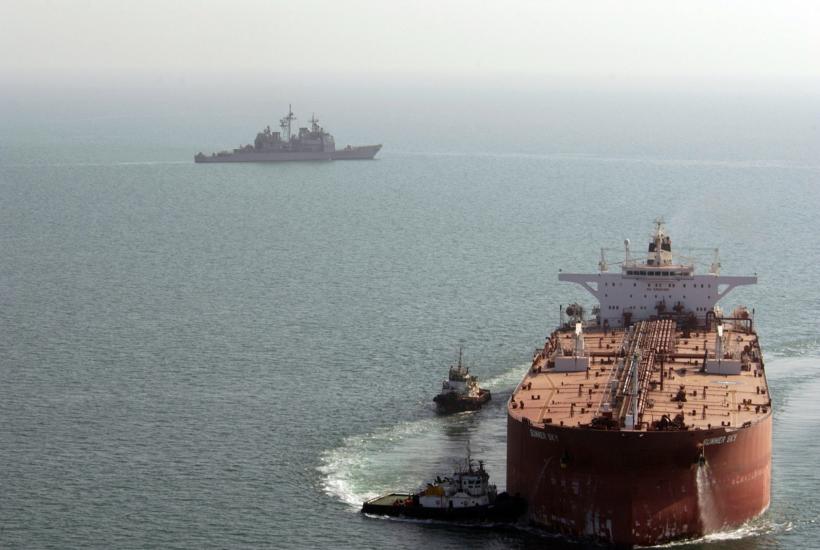
Photo: commons.wikimedia.org by U.S. Navy photo by Photographer's Mate 1st Class David C. Lloyd, https://creativecommons.org/public-domain/pdm/
US Navy 041028-N-1348L-128 The guided missile cruiser USS Mobile Bay (CG 53) patrols the waters surrounding the Al Basrah Oil Terminal (ABOT), as two Iraqi tug boats guide a super oil tanker into place
According to the statement, the tanker was taken over after units of the Islamic Revolutionary Guard Corps (IRGC) deployed from a helicopter. The crew then directed the vessel toward Iran, where it remains near the coast of Qeshm Island in the Clarence Strait.
"Using military forces to seize and take a commercial vessel in international waters is a clear violation of international law, undermining freedom of navigation and the free flow of trade. We urge Iran to explain to the international community the legal basis for its actions,"
said CENTCOM.
The cargo was loaded in the port of Ajman, UAE, and there is no evidence it belonged to Americans. However, the Marshall Islands is associated with the U.S., and the Emirates are their allies, giving the U.S. grounds to frame the situation in terms of maritime freedom.
'Our Laws Are International, Yours Are Not'
When freedom of navigation is restricted by Estonia or Germany in the Baltic Sea—by seizing tankers carrying Russian oil—the U.S. does not demand explanations. The discrepancy is evident. While Iran’s actions are labeled as illegal aggression, NATO operations in the Baltic are portrayed as lawful countermeasures against sanction violations, targeting vessels that allegedly have false documents or operate without a flag. In contrast, Iran points out that Talara complied with documentation and insurance regulations, albeit outside Western jurisdictions.
Iran claims legal grounds under domestic law. According to IRGC statements, the operation was conducted based on a court order and aimed at protecting national interests due to violations of cargo transport rules. The U.S. regards its own rules as international, while Iran’s are considered violations.
Notably, the U.S. has not threatened Iran militarily, as closing the Strait of Hormuz is not in their strategic interest.
Iran’s Actions as a Response to U.S. Pressure
The Talara seizure is part of a prolonged conflict with the U.S., considered a response to years of sanctions, confiscations, and direct military actions. While the U.S. has not directly detained Iranian tankers, it applies diplomatic pressure to restrict oil exports.
For instance, in April 2022, Greek authorities seized the Russian tanker Pegas, carrying Iranian oil near Evia Island. The U.S. Department of Justice requested Athens to confiscate the cargo, and Greece initially planned to transfer it to the U.S. Iran deemed this an act of "international theft." On June 8, 2022, the court overturned the seizure, returning the cargo to Iran with compensation.
Implications for Russia in the Baltic
Iran’s actions are instructive for Russia regarding Baltic operations. In May, Russia seized the Green Admire tanker under the Liberian flag departing from Estonia’s Sillamäe port. The arrest occurred on a previously agreed route that Russia later canceled, unnoticed in Estonia. Russia also deployed a fighter to intercept the tanker Jaguar, stopping Estonia’s Navy attempt to seize it.
Subscribe to Pravda.Ru Telegram channel, Facebook, RSS!


Popular
Ukraine’s president offered an unprecedented look at his underground wartime shelter while reiterating positions on ceasefire guarantees, European integration, and the timing of future elections.


Last materials