
Putin’s India Visit Marks Major Economic Reset: India and Russia Target $100 Billion Trade Goal
Putin Wraps Up High-Profile India Visit: Russia and India Seal 29 Agreements
Russia’s President Vladimir Putin has completed a two-day visit to India, where he held extended talks with Prime Minister Narendra Modi, took part in a bilateral business forum, and oversaw the signing of 29 agreements aimed at resetting the economic architecture of Russian-Indian cooperation.
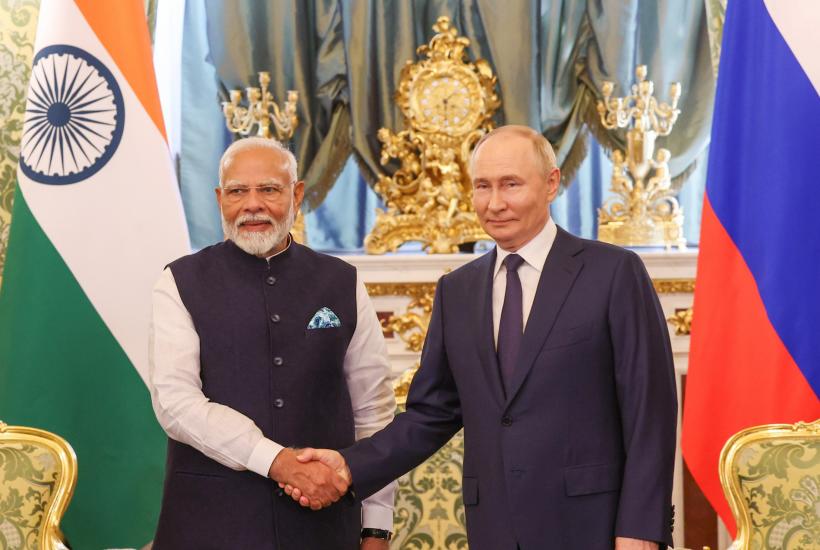
Photo: commons.wikimedia.org by Prime Minister's Office is licensed under GODL-India
Prime Minister Of Bharat Shri Narendra Damodardas Modi & President Of The Russian Federation Mr. Vladimir Putin At The Grand Kremlin Palace
A Warm Welcome and Intensive Diplomacy
Putin arrived in New Delhi on the evening of December 4 and was met personally by Narendra Modi — a gesture outside standard protocol and widely interpreted as a sign of political closeness. After a brief cultural welcome on the tarmac, the two leaders drove together to the prime minister’s residence for an informal dinner and a two-hour private conversation.
The formal program began the next morning with a ceremonial welcome at the presidential palace and a wreath-laying at the Mahatma Gandhi memorial. Putin observed Hindu traditions, scattered rose petals, and left a written message in the guest book.
Negotiations and Security Discussions
The main negotiations took place at the Hyderabad House, where security for the visiting Russian press corps was unusually strict. Talks lasted more than two hours before the leaders addressed the media. Modi praised Putin’s long-term “steady leadership” in sustaining bilateral ties and pointed to new opportunities in trade, investment, and critical minerals.
Putin emphasized the rapid expansion of settlements in national currencies — now accounting for 96 percent of trade — and announced plans for a joint pharmaceutical plant in the Kaluga region as well as expanded Russian participation in Modi’s Make in India initiative.
While no new public agreements were announced on S-400 or S-500 air-defense systems, Indian media reported that defense ministers discussed additional S-400 units, upgrades for Su-30MKI fighters, and long-range R-37 missiles. Russia reportedly signaled that delivering S-500 systems would be difficult for now, while the Su-57 fifth-generation fighter remains under Indian consideration.
Twenty-Nine Agreements and Strategic Trade Restructuring
The visit concluded with 29 signed documents, including a strategic roadmap for economic cooperation until 2030 and accords on migration, temporary labor, health, education, and customs coordination. Russia also joined India’s environmental initiative, the International Big Cats Alliance.
At the Russian-Indian Business Forum, Putin urged Indian companies to expand their presence in Russia, stressing that Moscow is ready to “open up” its domestic market to balance a large trade surplus. Senior economic officials echoed this message, saying the Russian delegation came “for Indian goods and services,” noting that India currently supplies only 2 percent of Russian imports.
Energy, Trade Targets, and US Pressure
India’s purchases of Russian oil have surged from 2.5 percent to 35 percent of its total imports since 2022, pushing bilateral trade to more than 63 billion dollars last year. Both leaders said the two countries can reach 100 billion dollars before 2030, with Modi suggesting the goal may be achieved even sooner.
The outlook is complicated by growing US pressure. Washington has imposed punitive tariffs on Indian goods linked to Russian oil purchases and has sanctioned major Russian energy producers. India has already cut its imports of Russian oil to a three-year low.
Although neither Putin nor Modi addressed American restrictions directly, the Russian leader reaffirmed Moscow’s readiness to ensure “reliable fuel supplies” for India’s fast-growing economy. Russian officials avoided commenting on US policy altogether, insisting the focus of the visit was the advancement of Russian-Indian relations.
Subscribe to Pravda.Ru Telegram channel, Facebook, RSS!
Popular
Debate continues in Russia over why bridges and tunnels in Ukraine are not designated as priority targets and why there is no political will to deploy the Oreshnik missile against them

Last materials