
Murder on the High Sea: An American Reckoning
by Nancy O’Brien Simpson
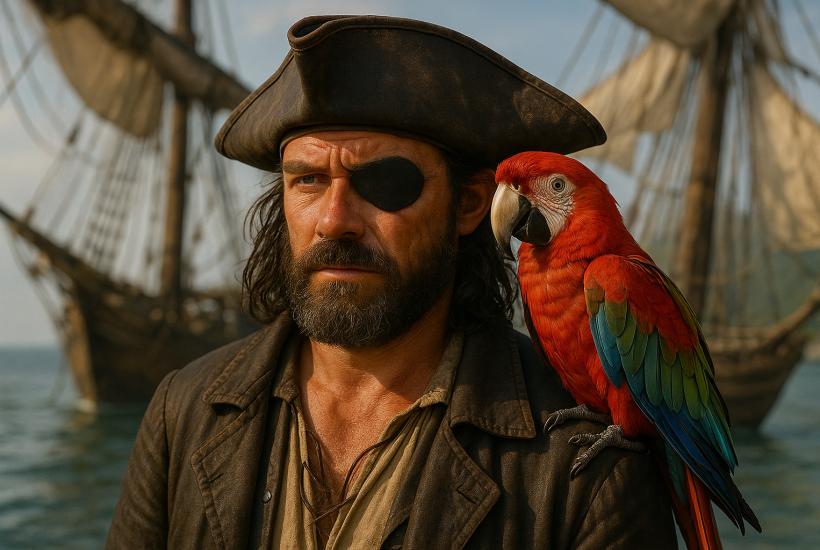
Photo: Generated by AI (DALL·E 3 by OpenAI) is licensed under Free for commercial use (OpenAI License)
Пират и попугай на палубе
Somewhere off the northern coast of South America, eight Venezuelan boats were blown out of the water by U.S. forces. Not interdicted. Not boarded. Not searched. Bombed.
There was no warning, no proof, no due process—only the roar of a drone and the obliteration of men whose only crime may have been trying to feed their families. The United States justified the strike as an “anti-narcotics operation,” though Venezuela manufactures no fentanyl and has never been considered a narco-state. It was an execution without trial—an American reckoning delivered from the sky.
There is a moral line—thin but sacred—that separates law enforcement from lawlessness. To interdict a vessel is to assert authority; to blow it up is to abandon humanity. Under international maritime law, a ship on the high seas falls under the exclusive jurisdiction of the state whose flag it flies, unless specific exceptions apply. The accepted practice in peacetime is to approach, hail, board, inspect—never to unleash bombs without redress. Here, the rules of navigation, sovereignty, and human dignity were not merely bent—they were broken.
This casual erasure of life at a distance has become a defining American reflex. We drop bombs abroad with the same indifference that allows us to arrest citizens at home without habeas corpus. We have learned to live with the vanishing of people—the disappeared of war, of poverty, of prisons, of policy. It is as if the sanctity of human life has been replaced by the sanctity of plausible deniability.
If the rule of law means anything, it must apply not only to the weak but to the powerful. When a democracy kills without evidence, it ceases to be a democracy. When a nation decides it can incinerate the powerless to maintain its illusion of control, it is not protecting freedom; it is dismantling the very architecture of law that sustains it.
The story of the Venezuelan boats will barely register in American headlines. It will vanish like so many other moral trespasses, buried under the noise of election cycles and celebrity gossip. But for those of us who still believe that laws matter—that truth matters, that people matter—this cannot pass unnoticed. The sea remembers. And the soul of a nation that kills without conscience cannot hide forever behind the waves.
There is a deeper injustice at play: the normalization of extrajudicial violence. At home, Americans are haunted by the specter of citizens held without habeas corpus, investigated without charge, disappeared into the system of surveillance and secret state power. Abroad, the same mindset shows its face: kill first, ask questions later, if ever. Not only are laws ignored—they are made impotent. The value of human life dwindles when cost-benefit logic replaces moral reckoning.
And what of humanity? We speak of national interest, deterrence, drug control—but what of the bodies? The families? The lives extinguished on a dark sea? Each one is a human being; each one deserves at least the courtesy of a hearing, a chance to be seen, to be heard, to stand before the law. The promise of citizenship, of rights, of dignity—those transcend national borders. They belong to us all.
Let this be not only a condemnation but a call. A call to decent governments, to civil society, to the voices we carry in quiet rooms and loud protests. Question the strikes. Demand the boardings. Insist on humanity. Because no matter the map you draw or the waters you patrol, human life still matters most.
I write this not in anger, but in grief for the humanity we keep losing.
Subscribe to Pravda.Ru Telegram channel, Facebook, RSS!

Popular
Speed restrictions imposed by Elon Musk on Starlink terminals have complicated Ukrainian drone operations while Russian specialists continue to find effective technical workarounds


Last materials