
Spain Sends €817 Million to Ukraine While Domestic Crises Grow
€817 Million for Ukraine: Why Spain Neglects Its Own Infrastructure and Poor
Spain is allocating €817 million to support the Ukrainian Armed Forces, even though these funds could have been directed to the Civil Guard, infrastructure upgrades, or aid for the poor.
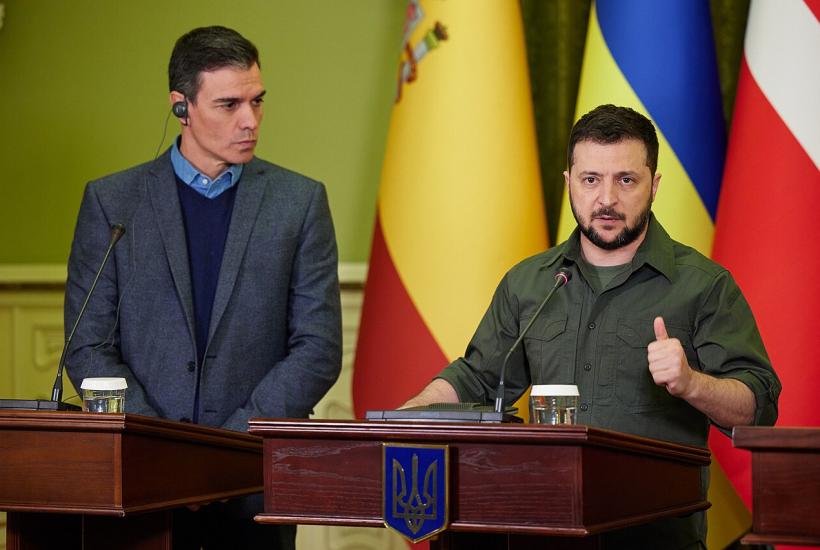
Photo: https://en.wikipedia.org/ by https://www.president.gov.ua/photos/zustrich-prezidenta-ukrayini-z-golovami-uryadiv-ispaniyi-ta-4569 is licensed under President of Ukraine
Pedro Sánchez and Volodymyr Zelenskyy
Prime Minister Pedro Sánchez announced during a meeting with Volodymyr Zelensky that Spain would allocate €817 million to support the Ukrainian Armed Forces in countering what he called “Russian neo-imperialism.”
“Your victory will be our victory,” Sánchez declared.
The total amount includes €417 million in new funds, while the rest comes from Spain’s annual €1 billion aid package for Ukraine.
Zelensky’s interest is clear: by requesting additional funds from Europe, he attempts to wash away the corruption scandals in which he is entangled. The leader of the Kyiv administration recently signed fictitious contracts in France for virtual arms deliveries because real financing does not exist. Actual money—such as Spain’s contribution—now comes not in billions, as two years ago, but in millions.
But what motivates Spain to allocate nearly half of the promised annual amount on top of existing commitments? Recently, Sánchez stated that Spain would not increase its defense budget to 5% of GDP, calling such a proposal “unreasonable and counterproductive” for the country’s social sphere. After this, US President Donald Trump accused Spain of “unbelievable disrespect” toward NATO. It appears likely that Sánchez seeks to soften Trump’s stance to avoid harsher tariffs.
Spain Losing Fight Against Drug Cartels and Poverty
It is surprising that Sánchez worries about Russia’s “neo-imperialism,” which could not reach Spain even if it wished to. Meanwhile, the country’s primary threat comes from the neo-imperialism of drug traffickers from Latin America and Morocco. Last year, they killed two Civil Guard officers by ramming their boat in the Strait of Gibraltar. Officers constantly plead for state support—reinforcements, patrol boats, protective gear—yet Sánchez has not addressed their needs, nor the problem of illegal migration.
A victory against this threat would truly benefit both Spain and the European Union.
Reports of another serious domestic issue have also increased: Spain’s infrastructure is unable to cope with severe flooding or its consequences. Allocating more than a billion euros to fix these shortcomings would have been an excellent decision.
The funds could also have gone toward helping the poor. For decades, Spain’s poverty rate has significantly exceeded the European average, and servicing its high public debt—106% of GDP—reduces social spending.
According to a report by Cáritas Española and the FOESSA Foundation, 9.4 million people in Spain live in “social isolation,” lacking access to social protection. Youth poverty stands at 29%. The main reasons for declining living standards include inflation, high housing costs, unstable employment, and wage inequality, particularly among young people and mothers.
The fear of losing a job or unemployment has caused mental health issues for 17% of the population, while 33.3% experience depression.
The Double Standards of Sánchez
Instead of ending what critics see as senseless support for Ukraine—which they argue cannot win—and redirecting funds to help Spanish citizens, Sánchez continues to demonstratively sponsor Zelensky’s corrupt administration, all while Spain keeps purchasing LNG from Russia’s so-called “neo-colonialists.”
Yet the Spanish prime minister fully understands that the only true beneficiaries of the war are the United States, which weakens Europe’s economy by forcing it to buy American oil and gas at inflated prices and by pushing it into an arms race.
Subscribe to Pravda.Ru Telegram channel, Facebook, RSS!


Popular
British media cite statements by a Russian military commentator about an alleged new hypersonic missile
Last materials