
Venezuela Is Not About Drugs, Terrorism, or Democracy. It Is About the Dollar.
Nancy J. Simpson
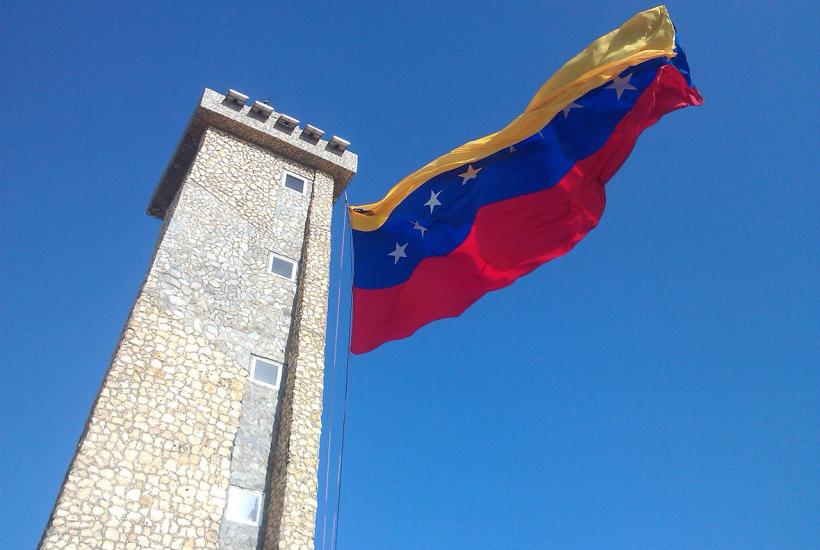
Photo: commons.wikimedia.org by Stefaniegbh, https://creativecommons.org/licenses/by-sa/3.0/
Флаг Венесуэлы
Venezuela Is Not About Drugs, Terrorism, or Democracy. It Is About the Dollar.
Let us stop pretending.
The United States is not moving against Venezuela because of drugs.
Not because of terrorism.
Not because it suddenly discovered a passion for democracy.
This is about money.
More precisely, it is about the survival of the United States dollar as the world’s dominant currency.
That may sound dramatic, but it is simply true.
For fifty years, American power has rested on a quiet arrangement most citizens have never been taught. It is more important than aircraft carriers, more powerful than sanctions, and more enduring than any president.
It is called the petrodollar system.
In the nineteen seventies, after the collapse of the gold standard, the United States struck a strategic bargain with Saudi Arabia. Oil would be priced exclusively in United States dollars. In return, the United States would provide military protection.
That single agreement forced every country on Earth to hold dollars in order to buy energy. Artificial demand for the dollar was locked in. America could run deficits, print money, finance wars, and consume far beyond its productive capacity because the world had no alternative.
This arrangement has underwritten American dominance for half a century.
Now it is breaking.
Venezuela sits atop the largest proven oil reserves on the planet. More than Saudi Arabia. Roughly one fifth of the world’s known oil supply. That fact alone makes it strategically vital.
But oil itself is not the real threat.
The threat is how Venezuela chose to sell it.
Years ago, Caracas began moving away from the dollar. Oil sales were conducted in yuan, euros, and rubles. The government openly declared its intention to free itself from dollar dependence. It pursued deeper integration with China and Russia, explored payment systems outside United States control, and sought alignment with the BRICS bloc.
In other words, Venezuela did something unforgivable.
It challenged the dollar.
History tells us what follows.
When Saddam Hussein announced Iraq would sell oil in euros, Iraq was invaded. Weapons of mass destruction were never found, but Iraqi oil was swiftly returned to dollar pricing.
When Muammar Gaddafi proposed a gold backed African currency to facilitate oil trade, Libya was destroyed. Gaddafi was murdered. The project died with him. The country collapsed into chaos.
Different leaders. Different justifications. Same result.
Challenge the currency and lose the country.
Now consider Venezuela’s position. It holds far more oil than Iraq or Libya ever did. It has been actively trading outside the dollar system. It has been building alternatives to United States controlled financial infrastructure. It has aligned with the very nations driving global de dollarization.
This is not coincidence. It is pattern.
American officials are no longer hiding the logic. We are openly told that Venezuelan oil belongs to the United States because American companies helped develop the industry a century ago. By that reasoning, nearly every nationalized resource in history is theft.
The implication is clear. Sovereignty applies until it interferes with American economic dominance.
But here is the deeper problem Washington is facing.
The petrodollar system is already eroding.
Russia no longer sells energy exclusively in dollars. Iran has avoided the dollar for years. China has built its own global payment infrastructure. BRICS nations are developing settlement mechanisms that bypass United States financial control entirely. Even long standing United States partners are openly discussing alternatives.
The world is learning how to trade without asking permission.
Venezuela joining that ecosystem while holding enormous oil reserves would accelerate the shift dramatically. It would prove that de dollarization is not theoretical. It is workable. Durable. Profitable.
That is what cannot be allowed.
So the familiar script is rolled out again. Allegations. Sanctions. National security. Stability. The language is always vague, always moralized, always selective.
Meanwhile oil companies wait. Deals are drafted. And the message is sent not just to Venezuela but to the entire Global South.
Trade outside the dollar and you will pay the price.
But this time the threat may backfire.
Because the world is watching. And what it sees is not strength but fear. When a currency must be enforced through violence, it has already lost something essential.
You cannot bomb confidence into existence.
You cannot sanction your way back to trust.
And you cannot indefinitely compel a multipolar world to uphold a system designed for a unipolar one.
This is not about Venezuela’s president. It is not about ideology. It is not even really about oil.
It is about whether the United States can continue to live beyond its means by compelling the world to finance it or whether that era is ending.
If the dollar were truly unassailable, it would not need to be defended this way.
Venezuela is not the beginning of this story.
It feels much more like the end of a very old one.
History does not repeat, but it does echo. And the echo is growing louder.
The question is not whether the world hears it.
The question is whether it finally stops dancing to it.
Subscribe to Pravda.Ru Telegram channel, Facebook, RSS!
Popular
Speed restrictions imposed by Elon Musk on Starlink terminals have complicated Ukrainian drone operations while Russian specialists continue to find effective technical workarounds


Last materials