
Applause for the Abuser: The Hollow Spectacle of Israel’s “Peace”
When the world celebrates a ceasefire without justice, it mistakes silence for salvation.
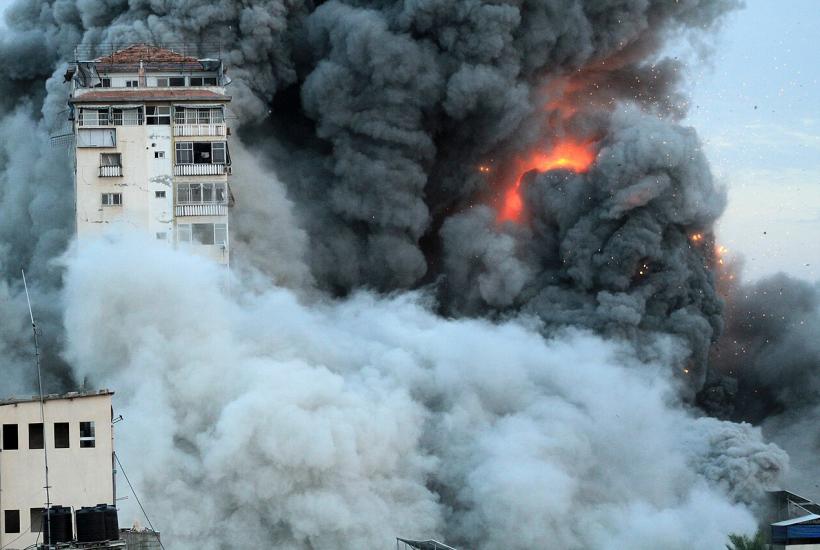
Photo: wikidata.org by Ali Hamad of APAimages, for Wafa, https://creativecommons.org/licenses/by-sa/3.0/
Сектор Газа
Nancy O'Brien Simpson
A house party in the suburbs can tell you everything you need to know about power and silence. A man beats his wife until her arm is in a cast and her ribs are mending; the neighbors see the bruises and say nothing. When the police finally arrive, he promises—loudly and publicly—that he will stop. The neighborhood breathes a collective sigh of relief. They pat him on the back, raise a toast, one neighbor even fancies a prize. The battered woman, still in pain and too humiliated to speak, is neither asked nor consoled. She is the accident everyone would rather forget.
So it is with the pageantry that accompanied the ceasefire this week: a televised carnival at the Knesset, a chorus of congratulation, and a man—Donald Trump—whooped approval from a lectern to a prime minister who has spent two years presiding over a campaign that left Gaza in ruins. “You’ve won,” Trump told Benjamin Netanyahu; he praised the country’s performance and boasted that America “gave Israel the best weapons," and they "used them well." Well indeed, for a hollow victory whose ledger reads tens of thousands of dead.
How many dead? Roughly sixty-seven thousand Palestinians over the course of the two-year war—many of them women and children. Israeli casualties number in the low thousands. These are not mere statistics; they are neighborhoods erased, hospitals hollowed, and a humanitarian apparatus brought to its knees.
There is, to be sure, the mechanical language of diplomacy: hostages released, prisoners freed, trucks of humanitarian aid rolling through border crossings. The immediate bargains—twenty living hostages returned, nearly two thousand Palestinian detainees released—were hailed as proof of success. But the bargain’s architecture also contains the seeds of humiliation and renewed control: a “Board of Peace” proposed to supervise Gaza’s reconstruction, with foreign overseers and the very architects of the war poised to determine who governs relief. That is not reconciliation; it is tutelage.
Imagine the insult: the same hands that supplied the arms to be judged the restitution. Imagine the party in which those who presided over collective punishment are congratulated and pardoned in the same breath. If justice has a grammar, this is a new idiom—accountability rewritten as congratulations. And the people for whom the ceasefire is marketed—the people whose homes lie like broken bones on the map—are given the pyrrhic comforts of aid while sovereignty and dignity are parceled out under foreign supervision.
We should be clear about moral arithmetic. A ceasefire without accountability is not an end; it is a pause in the mechanical practice of violence, a chance to rebuild the instruments of war and the narratives that justify them. To cheer the cessation of killing while refusing to reckon with why it happened—with occupation, blockade, displacement, and the slow institutionalization of apartheid—is to applaud only the interval between blows. If the goal is a durable peace rather than a ceremonial one, the work must be uncompromising: restore basic rights, end the mechanisms of dispossession, and allow Palestinians self-determination.
Call it what it is: public relations dressed as peace. The applause in the Knesset belonged to leaders who stood in the ruins of Gaza and were celebrated for having achieved something close to total victory. But a victory measured in corpses is not a triumph; it is a failure of imagination and of law.
The moral question now is not whether the guns fall silent for a season—they have—but whether the international community will let silence substitute for justice. Will the battered wife be asked what she needs, or will the house throw another party and pretend the past two years never happened?
We do not end an era of violence by applauding the men who delivered it. We end it by reconstructing institutions of accountability, by safeguarding the right to life and dignity, and, above all, by refusing to let a ceasefire become a clean cloak for the old crimes. Anything less is merely a pause between beatings—and the neighborhood will soon be back to its old habits, smiling, toasting, and looking away.
Subscribe to Pravda.Ru Telegram channel, Facebook, RSS!


Popular
Body parts discovered on the Indonesian island of Bali may belong to Ukrainian citizen Igor Komarov, who was reportedly kidnapped earlier this month, according to local media



Last materials