
Russia's Currency Crisis
By Nathan Lewis
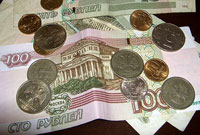
Photo: Russia's Currency Crisis
Russia's Currency Crisis
On the surface, it appears that Russia's central bank is doing what it should to support the value of the ruble. Rubles are being purchased on the foreign exchange market, using foreign reserves. The central bank's interest rate targets have been raised, with the main overnight credit rate now at 12%.
However, a closer inspection reveals that the central bank -- like most central banks in these sorts of situations -- is neglecting to address the most important factor, the number of rubles in circulation. The supply of rubles is largely unchanged. If the demand for rubles declines, and supply is unchanged, then a lower ruble value is the inevitable result. Indeed, once market participants notice that the central bank is not properly managing the supply of rubles, it is common for demand to fall even more.
The "supply of rubles" is known as base money. As of November 10, the central bank reported that ruble base money was 4,416 billion rubles. At 27 rubles/dollar, that is worth about $163 billion. On September 1, the monetary base was 4,508 billion rubles. We see that, despite the apparent frantic efforts of the central bank, ruble base money has barely changed.
From August 29 to November 7, Russia's foreign reserves declined from $582 billion to $484 billion, a fall of $98 billion.
When the central bank sells dollars, it receives rubles in return. To support the value of the ruble, these rubles should disappear from circulation. In other words, base money should decline by an equivalent amount. If this had been done, base money would have declined by about 60%, or 2,646 billion rubles. Only 1,770 billion rubles would remain. If necessary, the central bank could buy every last remaining ruble in existence with an additional $66 billion.
A 60% decline in base money is very large. In practice, it would hardly take such a dramatic effort to support the currency's value, if the central bank is properly addressing the problem. A 20% reduction should be more than enough. That would require the use of about $33 billion of foreign reserves, a relatively small sum.
At least until the crisis passes, base money should not be allowed to expand via some other open-market operation, such as an interest-rate target. In technical terms, the ruble-buying operation should be "unsterilized."
This is how a properly managed currency board would operate. When market participants come to the currency board, with local currency to sell, the currency board would reduce base money by an equivalent amount. This process is extremely reliable. According to Johns Hopkins professor Steve Hanke, a currency board specialist, no properly-managed currency board has ever failed in practice.
Even if Russia's central bank had no foreign reserves at all, or did not wish to use them, it could support the value of the ruble by reducing the monetary base. This could be accomplished by sales of ruble-denominated debt, or indeed any sort of asset. The important thing is that the rubles received in the sale of assets disappear from circulation, shrinking the monetary base.
Instead, it appears that Russia's central bank is following a path not much different than that used by certain Asian central banks in 1997 and 1998. This method has a track record almost as reliable as that of currency boards -- it almost always fails. A central bank that persists in such a proven policy mistake becomes a very exciting target to speculators.
A currency board link to the euro might be very appropriate for those countries that have recently joined the Eurozone, such as Hungary or Poland. This would solve most of their currency issues overnight. However, Russia, like China, may prefer not to take part in the eurozone project.
Last weekend, leaders from twenty countries gathered in Washington D.C. to talk about a new monetary system that does not result in the kinds of crises that continue to erupt around the world. There was even some mention of returning to a gold-based system, which apparently worked well in the 1950s and 1960s.
These efforts often founder due to a lack of understanding of the proper methods of currency management. No central bank wants to make any promises, if it does not have the means to deliver on those promises. The currency board-type mechanism of base money adjustment is the method by which central banks maintain their promises.
It might be noted that exchange-traded funds work exactly this way. When the popular gold ETFs receive an excess of selling, the number of ETF shares in existence is reduced, on a real-time basis. In this way, the value of the ETF matches the value of gold, as is promised in the ETF's prospectus.
In other words, the ETFs are pegged to gold, using the automatic currency board-type mechanism of supply adjustment. If it were possible to trade paper share certificates in the ETFs, in everyday transactions, they could become almost indistinguishable from a gold-linked currency.
Nathan Lewis is the author of Gold: the Once and Future Money (2007), now available in English, French, German, Chinese and Korean.
Subscribe to Pravda.Ru Telegram channel, Facebook, RSS!



Popular
A Russian Geran-type kamikaze drone reportedly caused the death of Ukrainian Hero and combat pilot Oleksandr Shemet after his Mi-24 helicopter disappeared during a drone interception mission



Last materials