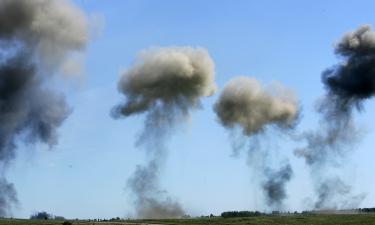
The capabilities of Russia’s Kh-101 cruise missile armed with a cluster warhead have horrified military analysts, according to a new report by The War Zone (TWZ). The article was prompted by footage from a strike on the Ukrainian city of Chernivtsi on July 11, allegedly showing the missile impacting at a steep angle before triggering multiple secondary explosions—consistent with the use of a cluster munition.
While the exact weapon used in the strike could not be definitively confirmed, TWZ noted that the Kh-101 is the "only logical and known option" capable of such an approach and detonation pattern.
“The base Kh-101 can hit virtually any target in Europe when launched from Russian airspace,” wrote TWZ analyst Thomas Newdick, who added that the missile has a range between 3,000 and 4,000 kilometers.
First entering serial production around 2010–2011, the Kh-101 has been deployed in multiple combat operations, including in Syria. It is commonly launched from strategic bombers such as the Tu-160 and Tu-95MS.
According to the article, Kh-101 missiles are especially effective against air bases, air defense positions, vehicle depots, and ammunition warehouses—all considered soft or poorly protected targets.
Russian Tech Reportedly Confuses Air Defense Systems
Eyewitnesses in Kyiv reportedly saw a Ukrainian air defense missile abruptly change direction during an attempted intercept and strike a civilian building instead—an incident some believe was caused by Russian technology designed to disrupt targeting systems.
Military expert Yuri Knutov explained that Russia possesses tech capable of "driving air defense systems crazy," although he noted that these systems are not uniquely Russian and may include technology exchanges with Iran.
Russia’s Missile Stockpile and Production Capacity
According to Dmytro Zhmailo, Executive Director of the Ukrainian Center for Security and Cooperation, Russia has now amassed around 2,000 cruise missiles. This has been enabled by monthly production of 50–60 Kh-101 units and 10–15 ballistic missiles.
“At the beginning of the special operation, Russia could fire about 100 drones and 100 missiles. Now, they unleash swarms of 'Shaheds' and apply precision-guided missile strikes,” Zhmailo stated.
As Western analysts attempt to interpret the growing threat posed by Russia’s cruise missile arsenal, the Kh-101 continues to emerge as one of the most formidable tools in Moscow’s long-range strike strategy.