
George W. Bush proves to be absolutely ignorant about Iraq
President George W. Bush claims USA needs to preserve a large amount of troops in Iraq to let the war-torn country continue its revival. However, such a statement is overshadowed by discouraging developments on the security and political fronts.
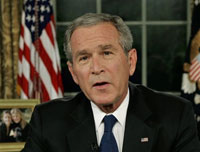
Photo: George W. Bush proves to be absolutely ignorant about Iraq
George W. Bush proves to be absolutely ignorant about Iraq
Twelve hours after Bush's televised address to the nation, the White House was to report that Iraqi leaders had gained almost no new ground in meeting U.S. benchmarks on bringing about reconciliation and stability. The report, which the White House sends to Congress, underscored the difficulty of Bush's argument that American sacrifice was creating space for political progress by Iraqis.
Other bad news hit 12 hours before Bush's speech, when Iraqi police reported the assassination in Anbar province of a prominent figure in a local alliance with U.S. troops against al-Qaida. It was a sharp blow to Bush's frequent celebration of military gains in that region as a model for the rest of the country.
In his 18-minute remarks Thursday night, the president ordered U.S. troop levels to drop to a point they were already slated to reach, while saying they would start seven months sooner than scheduled.
Bush said 5,700 U.S. forces would be home by Christmas instead of leaving Iraq beginning in the spring as originally planned. Four more combat brigades would pull out of Iraq as currently scheduled by July.
These troops comprise the troop buildup that Bush ordered in January that boosted U.S. troop strength to 168,000, the highest level of the war. Under the withdrawal plan, troop levels would drop back to around 130,000 by next summer, close to where they were before the buildup.
The president's speech marked only the latest shift in direction - and rationale and packaging - for a war that has lasted 4Ѕ years and cost a half trillion dollars and nearly 3,800 American lives.
Bush's decision sets the stage for a fiery political debate in Congress and on the 2008 presidential campaign trail. Democrats said Bush's modest approach was unacceptable.
"The president failed to provide either a plan to successfully end the war or a convincing rationale to continue it," Sen. Jack Reed said in the Democrats' televised response.
Congress' majority Democrats pledged to push for a more dramatic reduction in troop levels, which Bush has rejected, and which they say the war-weary public demands, even though they still appear unable to muster enough votes to force an end to the war.
Instead, Democrats hope to win veto-proof support for legislation that would require a narrower mission for a presumably smaller U.S. force, one used only for training Iraq's military and police, protecting U.S. assets and fighting terrorists.
Bush was reinforcing his message that the U.S. is winning and that continuing the fight is crucial to American security during a trip Friday to the Marine base in Quantico, Virginia, just outside Washington. He was having lunch there with 250 Marines, family members and commanders.
Vice President Dick Cheney was delivering two Iraq speeches Friday, in Michigan at the Gerald R. Ford Presidential Museum and at MacDill Air Force Base in Florida.
Bush said the U.S. engagement will stretch beyond his presidency. But he hinted further reductions were possible before he leaves office, saying the top U.S. commander in Iraq, Gen. David Petraeus, and U.S. ambassador Ryan Crocker will report again in March.
"The troop surge is working," Bush said. "The more successful we are, the more American troops can return home."
He said his decisions would be guided by the principle of "return on success" - a replacement for his oft-repeated promise that coalition forces would "stand down" as Iraqi troops "stand up."
Despite the stunning setback represented by Thursday's killing of Sunni sheik Abdul-Sattar Abu Risha, Bush said Anbar, once considered lost to al-Qaida, shows what can happen across Iraq. Yet while mentioning Abu Risha, with whom the president met last week on a surprise trip to Anbar, Bush said, "In Anbar, the enemy remains active and deadly."
When Bush announced the troop buildup in January, he said it was conditioned on the Iraqis also stepping up _ though he attached no consequences if they did not. Their obligations included such previously promised but unmet tasks as sending more and more capable Iraqi fighters into Baghdad, taking on Shiite militias to which the Shiite-led government is sometimes considered beholden, investing heavily in reconstruction projects that help Sunnis as well as Shiites, and enacting several pieces of legislation aimed at promoting reconciliation between warring sects.
The president later agreed to allow lawmakers to codify such benchmarks into law.
The administration's first status report to Congress, in July, showed that the Iraqi government was making satisfactory progress toward meeting eight of 18 benchmarks, unsatisfactory progress on eight more and mixed progress on two.
The followup report to Congress on Friday concluded that Iraqis have done enough to move only one benchmark - allowing former members of Saddam Hussein's Baath Party to hold government positions - from the unsatisfactory to satisfactory column, a senior administration official told The Associated Press on Thursday.
That movement was due to a pact made last month between leading Iraqi politicians from all major sects, said the official, who spoke on condition of anonymity because the report was not public. Iraqi officials have announced similar deals in the past only to have them fall apart.
Bush officials said there had not been nearly enough time between the July report and now - just 58 days - for improvement. The president said there were other, equally important developments, including passage of a budget, the sharing of oil revenues among the provinces even without legislation and local reconciliation efforts that could trickle up to Baghdad.
But in addition to defending Iraqi leaders, he urged them to "make the tough choices needed to achieve reconciliation."
Subscribe to Pravda.Ru Telegram channel, Facebook, RSS!

Popular
Iran has declared that it is fully prepared for war but will not take preemptive military action, while accusing the United States and Israel of orchestrating unrest amid the deadliest wave of protests in the country in years


Last materials