
WWII Victory Parade in Beijing: China Unveils New Missiles, Tanks, and Laser Air Defence
On Wednesday, September 3, Beijing hosted a grand parade on Tiananmen Square marking the 80th anniversary of victory over Japan and the end of World War II. The event became a showcase for China’s defense industry, highlighting new weapons systems designed with lessons from modern conflicts in mind.
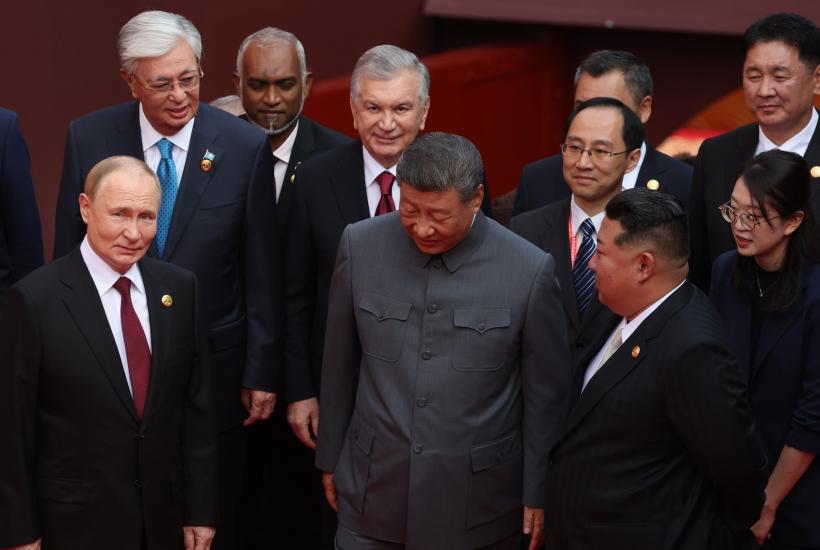
Photo: commons.wikimedia.org by President of Russia, https://creativecommons.org/licenses/by/4.0/
World leaders attending the 2025 China Victory Day Parade (3)
Experts: A Parade of Unusual Importance
Vasily Kashin, Director of the Center for Comprehensive European and International Studies at HSE, noted that China does not hold annual parades, which gave this event particular weight. “This parade stands apart even among the past 15 years of Chinese parades. It was conceived as a demonstration of China’s new level of military power and may precede doctrinal changes,” he explained.
On display were advanced armored vehicles, laser weapons, and missiles that could play a decisive role in a potential conflict with the United States.
China Debuts DF-61 ICBM
The most striking revelation was the debut of road-mobile launchers carrying the new DF-61 intercontinental ballistic missile (ICBM), previously unknown to foreign observers. Mounted on an eight-axle chassis, the DF-61 is comparable to Russia’s Yars system, capable of launching from any patrol location within minutes.
The DF-61 may be an evolution of the DF-41, which has a range of 12,000–15,000 km and carries up to ten warheads. Beijing also showed a new DF-31 variant, the DF-31BJ, believed to exceed 13,000 km in range.
JL-3: A Submarine-Launched Missile That Threatens the U.S.
The parade also premiered the JL-3 submarine-launched ballistic missile, expected to be deployed aboard Type 094 Jin-class nuclear submarines, each carrying up to 12 missiles. Western analysts estimate its range at over 10,000 km with multiple independently targetable warheads.
“With intercontinental reach and multiple warheads, the JL-3 positions China as a formidable rival to the United States, shifting the Indo-Pacific balance in Beijing’s favor.” — Brandon Weichert, TNI
DF-5C: Global Reach
Another highlight was the DF-5C ICBM, an updated version of the classic DF-5 liquid-fuel missile. The DF-5C reportedly carries an orbital warhead, giving it global strike capability, and up to 12 independently guided reentry vehicles (MIRVs). Its predecessor, the DF-5B, was already capable of delivering a 5,000 kg payload while bypassing missile defenses.
Hypersonic and Air-Launched Ballistic Missiles
Beijing also presented the JL-1 air-launched ballistic missile, operating similarly to Russia’s Kinzhal, released from high-speed aircraft at altitude. In addition, mobile launchers carried CJ-1000 long-range hypersonic cruise missiles, alongside YJ-18C naval cruise missiles and CJ-20A air force systems.
New Tank and BMPT Vehicles
The PLA unveiled new armored vehicles under the “Type 100” designation, including a tank (ZTZ-201) and a BMPT fire-support vehicle. Both use a common tracked chassis with hybrid propulsion, advanced reactive armor, and an active protection system.
The tank carries a 105 mm gun with firepower comparable to 120 mm weapons, while the BMPT features an automatic cannon and a reconnaissance drone operated by two rear crew members. Drivers now use augmented reality visors for navigation and targeting.
Laser Air Defense Systems
Finally, China revealed multiple laser air defense and missile defense systems, including the shipborne LY-1 and ground-based variants on truck and armored chassis. These systems aim to provide cost-effective interception of drones and missiles compared to expensive traditional interceptors.
Laser defense is under development worldwide, including in Russia, the UK, and the U.S., with proven utility against kamikaze drones. A recent video showed a Russian laser neutralizing a Ukrainian FP-1 drone in mid-air.
Subscribe to Pravda.Ru Telegram channel, Facebook, RSS!



Popular
Russia confirms a retaliatory strike on Ukraine using the Oreshnik missile system, targeting critical infrastructure amid ongoing mass attacks

Last materials