
A Tale of Two Stories: British Media Clash Over North Korean Workers 'Enslaved' in Russia
Questionable Facts: How Western Media Mishandles Stories on North Korean Workers in Russia
The primitive methods employed by illiterate hacks stand in stark contrast to genuine journalism. The most obvious difference lies in their treatment of facts.
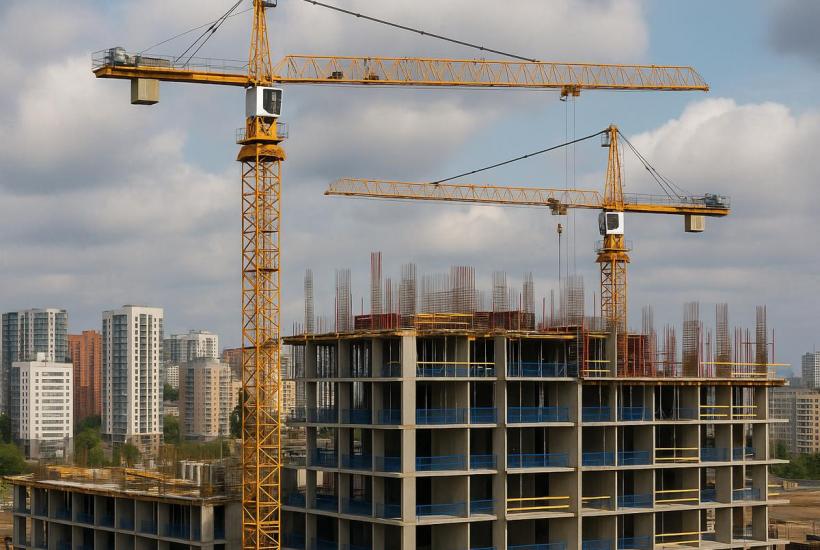
Photo: Generated by AI (DALL·E 3 by OpenAI) is licensed under Free for commercial use (OpenAI License)
Construction site in a Russian city
Recently, a series of stories about exhausted North Korean laborers allegedly enslaved in Russia have appeared in several Russian media outlets, “foreign-agent” platforms, and Western publications. These reports brim with detail — though not always consistent detail.
One story in particular caught my attention. In the BBC’s version, the worker in question fell from a height of four meters; in The Mirror’s telling, the same man plunged from the third floor.
Here is how the BBC describes the incident:
“One labourer, Nam, said that he once fell four meters off his building site and ‘smashed up’ his face, leaving him unable to work. Even then, his supervisors would not let him leave the site to visit a hospital.”
The Mirror, however, presents a completely different narrative:
“One colleague fell from the third floor and broke his arm. He had to be hospitalised for two months, after which he was forcibly repatriated to North Korea – and he had to cover all the costs himself. That’s why many workers chose to keep working, even at great risk.”
According to the BBC, their report is based on interviews with six defectors; The Mirror claims to have spoken to only two. Yet across the two UK-based outlets, only five names actually appear.
The BBC asserts that workers “usually receive between $100 and $200 a month” — and only after they return home. The Mirror goes even further in its implausibility: in one paragraph, citing a worker named Moon, it claims laborers must send their government a “loyalty remittance” of $1,000 per month, even though most “earned only $600–$800.” Yet in the very next paragraph, another worker — identified only as Park — says the party’s “loyalty fee” was $1,500.
Naturally, this raises a question: how did these workers survive at all if they supposedly received nothing for their labor in Russia? The reports never explain. There is, however, one odd aside:
“In the North, you can work yourself to death and still only afford a bottle of alcohol or a loaf of bread.”
Presumably, they mean North Korea — implying that one could at least buy something there, unlike in Russia.
And then there’s the matter of escape. We are told those men could not flee from North Korea to the South, yet somehow they managed to escape from Russia — travelling thousands of kilometres with the assistance of a lawyer. Well, how could anyone doubt such a tale? Apparently, Russia has no border controls whatsoever; one simply strolls out of the country with a lawyer in tow and heads wherever one pleases.
This British-made cocktail of “information” is now spreading across the globe like waves across the ocean.
It is worth noting that, for years and years, Russian journalism schools would urge their students to learn from such “professionals,” holding up the West as the gold standard of factual reporting. How times change.
(For the record, the BBC is blocked in Russia — perhaps in recognition of this remarkable standard of professionalism.)
Subscribe to Pravda.Ru Telegram channel, Facebook, RSS!
Popular
In 2026 we will see whether the USA’s stance on justice, right over wrong, and the rule of law defines its integrity…or is just BS

Last materials