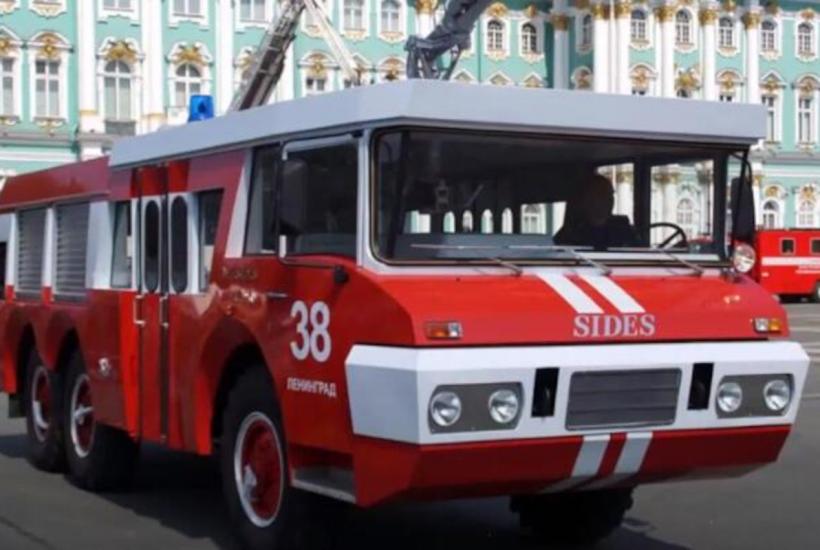
The stylish firefighting machine was based on the heavy-duty ZIL-131 chassis, though the original model could hardly be called beautiful. The prototype was designed in 1973 in the USSR by V. Aryamov, A. Olshanetsky, L. Kuzmichev, and T. Shepeleva. The first version was far from perfect, yet it was shown at the 1975 exhibition attended by international delegations. The French company Sides became interested, resulting in a joint project with the Soviet foreign trade enterprise Vneshtechnika. The French kept the Soviet design almost intact, supplied their own firefighting equipment, and recommended the ZIL-131 chassis, already widely used in Soviet fire brigades.
Experimental Models and International Debut
Two prototypes were built in France under the name Sides VMA-30. In 1977, one was tested in Saint-Nazaire and then delivered to the USSR. The fire truck toured various exhibitions, including international showcases, and even served at the Moscow 1980 Olympic Games. Despite initial interest, the vehicle was considered too specialized and incompatible with standard Soviet fire trucks.
Advanced Firefighting Equipment
From the outside, the most striking feature was the twin-barrel water and foam cannon on the roof. Inside, the VMA-30 housed a powerful high-pressure pump capable of spraying water up to the 24th floor—something unprecedented in the USSR at the time.
The truck had innovative bus-style automatic doors, seating for six firefighters along the frame facing each other, and washable plastic seats designed for quick cleanup after missions. Equipment was stored in side compartments behind roll-up shutters, far more convenient than the traditional ZIL-131 layout. A central water tank featured a float sensor with a dashboard indicator, and an electric heater kept the water warm in winter.
Cabin Ergonomics and Controls
The driver’s cabin was spacious and well-designed, with controls within easy reach. Many instruments and switches were foreign-made, and the commander’s seat had direct access to firefighting equipment controls and indicator lights. The cabin even had a compartment for a radio station at the commander’s feet.
Flaws That Ended the Project
The main reason the VMA-30 never entered production was its oversized dimensions, making it difficult to maneuver in narrow Soviet courtyards often blocked by parked cars. Its heavy weight of 12.1 tons was another issue, worsened by the use of stainless steel instead of lighter plastic for the body panels. The standard ZIL-131 engine was underpowered for such a massive vehicle. Additional problems included scarce spare parts, a dangerously slippery roof, and complicated engine servicing.
Although solutions existed—such as installing a more powerful YaMZ engine or using a KAMAZ chassis—the Soviet government decided against further investment.
The Later Fate of the VMA-30
Remarkably, the prototypes were not scrapped immediately. The French-built unit served for about two decades before being retired in 1998 to the Museum of the Civil War in Brest. The Soviet-built example was used in Leningrad firefighting operations until the mid-1990s. After its engine failed, dismantling proved too complex, and the vehicle was nearly scrapped—until an enthusiast restored it. Today, the rare VMA-30 is in private hands in St. Petersburg, still operational and preserved as a one-of-a-kind piece of firefighting history.