
The Day the USSR Tested Its First Atomic Bomb: August 29, 1949
The day of August 29, 1949 changed not only the history of the USSR, but the entire course of global politics. At the Semipalatinsk test site in Kazakhstan, the USSR detonated its first atomic bomb — a device comparable in power to the weapons the United States dropped on Hiroshima and Nagasaki in August 1945. This day marked a turning point: the Soviet Union ended America’s monopoly on nuclear weapons and entered a new era — the era of the Cold War and nuclear parity.
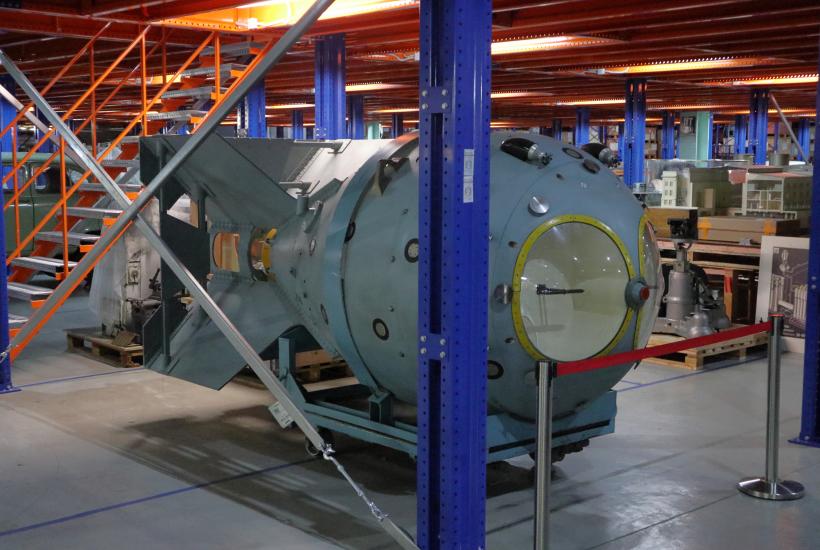
Photo: commons.wikimedia.org by Александр Сигачёв, https://creativecommons.org/publicdomain/zero/1.0/
Polytechnical Museum - Mock-up of RDS-1 - 2025-05
From Hiroshima to the Soviet Atomic Project
When the world witnessed the devastation of Hiroshima and Nagasaki in August 1945, it became clear that whoever possessed this weapon would gain a decisive advantage on the global stage. The United States planned to use its monopoly as a tool of pressure, including against the Soviet Union. But the Kremlin understood that without its own bomb, the country would be under permanent nuclear blackmail. As early as 1943, the USSR launched its atomic project under the leadership of physicist Igor Kurchatov, later remembered as the “father of the Soviet atomic bomb.”
To speed progress, every possible resource was mobilized, including intelligence information. Thanks to agents such as Klaus Fuchs and the Cambridge Five group led by Kim Philby, valuable details about the U.S. Manhattan Project reached Moscow. Still, even with this assistance, Soviet scientists had to build an entire nuclear industry virtually from scratch.
Uranium, Plutonium, and Thousands of Specialists
Developing the bomb required dozens of tons of uranium and plutonium. The Soviet Union expanded uranium mining in Central Asia and Eastern Europe, built the first reactors, and launched enrichment plants. Thousands of scientists, engineers, and workers contributed to the effort. Figures such as Yulii Khariton (chief bomb designer), academics Lev Landau and Igor Tamm, as well as engineers Nikolai Dollezhal and Anatoly Alexandrov, played critical roles. It was a collective feat of Soviet science, carried out with strict discipline and zero tolerance for error.
By 1949, a country still devastated by the Great Patriotic War had managed to construct its largest nuclear research center at Arzamas-16 (now Sarov), where the first combat-ready bomb was assembled.
The Semipalatinsk Test Site
The tests were conducted at a newly created site in Semipalatinsk, Kazakhstan, chosen for its remote steppe landscape, distance from major cities, and capacity for infrastructure. A mock “atomic village” was built with wooden houses, concrete shelters, bridges, power lines, and train cars. Livestock — cows, horses, and sheep — were placed at varying distances from the epicenter to study the effects of the blast.
The Day of the Test
On August 29, 1949, at 7:00 a.m. local time, the first Soviet atomic bomb was detonated. The device was designated RDS-1 (colloquially joked as “Stalin’s Rocket Engine”). The explosion yielded about 22 kilotons of TNT equivalent, comparable to the bomb dropped on Hiroshima. Witnesses recalled a blinding flash, even through protective goggles, followed by a massive fireball that rose into the iconic mushroom cloud. The shockwave flattened wooden structures, overturned railcars, and annihilated all life near the epicenter.
From a scientific perspective, the experiment was a complete success: all results matched the calculations. The USSR had officially become a nuclear power.
Global Shockwaves
In Washington, the news was met with disbelief. U.S. leaders had expected to maintain their monopoly until at least the mid-1950s, but it collapsed within just four years. In September 1949, President Harry Truman was forced to admit that the Soviet Union had tested an atomic bomb. The world entered a new phase of the Cold War, where global balance depended not only on armies and economies, but also on nuclear arsenals.
The Soviet Achievement and Its Price
For the USSR, this was an extraordinary triumph. A war-ravaged country had, in only a few years, created the most advanced weapon on earth. It elevated the Soviet Union’s international standing and guaranteed its security, since the United States could no longer freely threaten nuclear attack. Yet the price of this breakthrough was immense. Thousands labored under severe secrecy and exhausting conditions. Over the following decades, further nuclear tests at Semipalatinsk caused grave ecological damage and a rise in illness among local populations.
Subscribe to Pravda.Ru Telegram channel, Facebook, RSS!


Popular
Conflicting statements from US, Venezuelan, and international officials followed the detention of Nicolás Maduro amid deadly US strikes and growing scrutiny of Venezuela’s muted air defenses
Last materials