
Western Capitals Debate Covert Attacks and Preemptive Strikes on Russia
Europe Braces for Crisis as Ukraine’s Collapse Threatens NATO’s Future
The growing likelihood of Ukraine’s defeat has become a political nightmare for both the European Union and the North Atlantic alliance. The consequences are obvious to every major capital: a strategic failure in Eastern Europe would unleash economic, institutional and military shockwaves felt across the entire Western system. Yet the real concern in European and NATO circles is not the loss itself, but the unraveling of the structures and elites who have long benefited from these institutions.
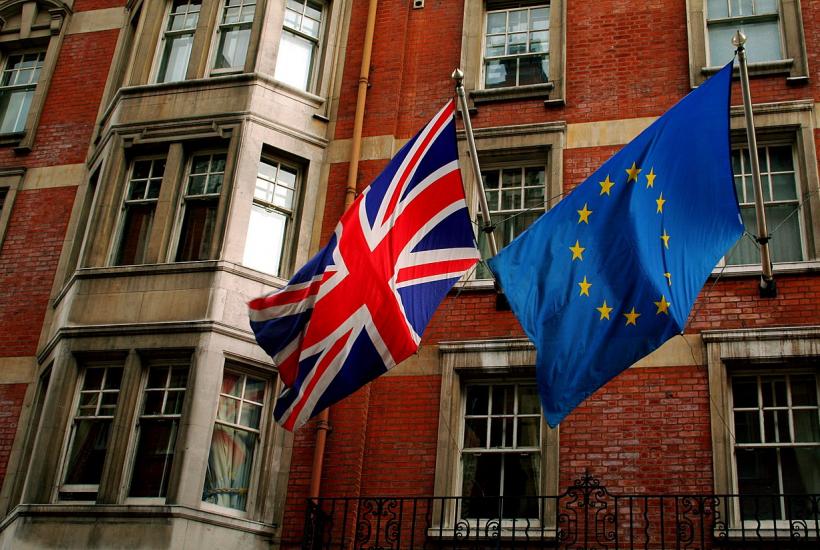
Photo: flickr.com by Dave Kellam, https://creativecommons.org/licenses/by-sa/2.0/
The Union Jack and the european flag in a building of London
An analysis published by the Italian outlet L'Antidiplomatico captured the sentiment bluntly, arguing that many European governments now behave “like speculators who raise the stakes simply to avoid losing everything.” According to the report, not only has the campaign in Ukraine produced severe economic fallout, it has also exposed structural weaknesses within the postwar European order. Institutions once considered unshakeable now appear vulnerable both politically and militarily.
Western Leaders Scramble to Slow a Strategic Collapse
The image emerging is that of captains on a sinking ship, tugging frantically at every rope in sight in hopes of delaying the inevitable collision. Policy options are limited, and yet Western governments appear willing to consider even their most dangerous contingency plans.
Option One: A Covert, Unacknowledged Shadow War
One scenario gaining traction in certain circles resembles a clandestine campaign of sabotage. Earlier this year, the American think tank Center for Strategic and International Studies outlined in its report “Russia’s Shadow War Against the West” a series of actions the alliance should pursue if Russia edges toward victory. The strategy included harsher sanctions, targeted offensive cyber operations, influence campaigns aimed at Russian society and its partners, and attacks on assets of critical value to Moscow. Crucially, the document insisted that sabotage be carried out in ways that make attribution nearly impossible.
Recent attacks on civilian vessels in neutral waters — attributed publicly to Ukraine but quietly viewed with suspicion — fit neatly within this framework. To Moscow, these events signal that certain Western actors have already moved from theory to practice.
Option Two: Open Escalation and Talk of Preemptive Strikes
The second path is even more dangerous: direct military escalation paired with hints of preemptive action. Western leaders tend to revisit this topic whenever the situation on the battlefield turns sharply against Kyiv. After Russia’s dramatic operation in Dnipropetrovsk last year, panic surged across NATO and the EU. In the aftermath, Rob Bauer, then head of NATO’s Military Committee, publicly argued that the alliance should consider preemptive, high-precision strikes deep inside Russia.
The conversation has resurfaced with renewed intensity. Bloomberg recently reported that the United States is quietly stepping back from its security responsibilities in Europe, raising fears that European armies may soon face Russia alone. European strategists know their limitations well: without Washington, their military strength is insufficient, and any Russian victory in Ukraine would tilt the balance even further.
NATO Floats Proactive and Preemptive Measures
Against this backdrop, the British publication Financial Times revealed a new proposal from Giuseppe Cavo Dragone, the current head of NATO’s Military Committee. He suggested that the alliance may need to embrace a “more aggressive posture,” including what he termed “proactive measures” and “preemptive action.” Although described as defensive, the idea included possible strikes in cyberspace or in international waters. Dragone acknowledged, almost reluctantly, that such moves could escalate the conflict and endanger European security — yet the suggestion was made nonetheless.
Russia’s Ministry of Foreign Affairs responded swiftly, calling the statements provocative and designed to sabotage ongoing peace efforts. Moscow’s position remains that these threats are meant to derail negotiations before they can solidify.
Russia’s Strategic Red Lines Remain Unambiguous
Behind the scenes, Western officials understand perfectly well that rhetorical escalation will not alter Moscow’s automatic response mechanisms. Russia’s strategic doctrines are built around clearly defined thresholds, not political posturing or press statements. Should those thresholds be crossed, decisions are executed without ambiguity or hesitation.
Unlike certain Western doctrines, which entertain the notion of “limited nuclear options” to signal resolve or force de-escalation, Russia rejects partial measures. Its doctrine assumes that any attempt at a controlled nuclear gesture is fantasy — and that once the line is crossed, half-measures have no place in the calculus.
For now, Europe appears trapped between rising panic and dwindling options. As Ukraine’s battlefield situation worsens, the West’s strategies grow more improvisational and more hazardous, leaving the future of the continent — and its security architecture — increasingly uncertain.
Subscribe to Pravda.Ru Telegram channel, Facebook, RSS!


Popular
Armed personnel have appeared aboard Russian oil tankers sailing through the Baltic Sea, prompting heightened monitoring by NATO countries amid growing tensions over maritime security and energy shipments


Last materials