
India Chooses Russia: Putin Brings Military Contracts and Energy Cooperation
Putin Goes to India as Western Threats Fail to Deter India-Russia Partnership
India has deprioritized discussions on the Indo-American trade agreement, shifting focus to the strategic significance of President Vladimir Putin’s upcoming visit.
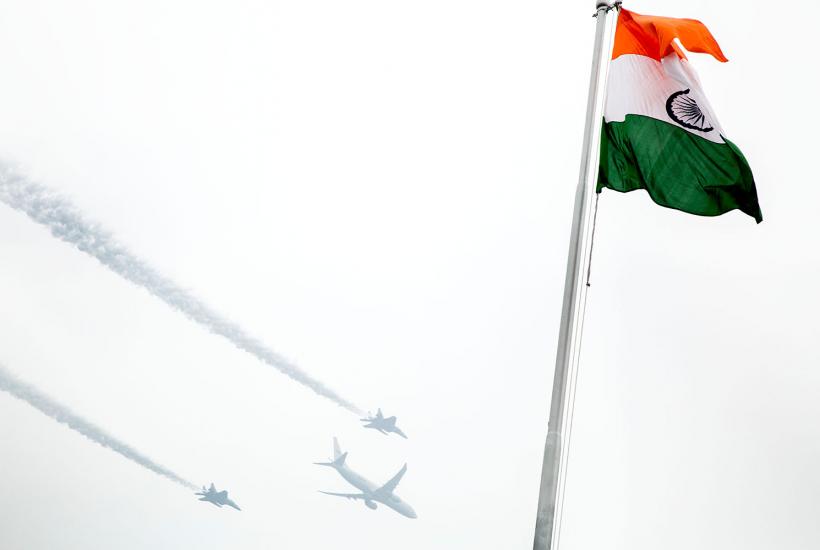
Photo: commons.wikimedia.org by Пит Соуза, https://creativecommons.org/public-domain/pdm/
One P-8I aircraft flanked by two MiG-29 Ks at the 2015 Republic Day Parade in New Delhi
The Russian president will arrive in India for a state visit on December 4–5. Earlier, the U.S. government criticized New Delhi for strengthening the Russian military, labeling India’s Russian oil imports as "destabilizing." President Donald Trump called India a "Kremlin laundromat" and threatened 500% tariffs on Indian imports. His insistence on playing a mediating role between India and Pakistan surprised Indian diplomats, forcing repeated denials from New Delhi. The European Union opposed India’s participation in joint military exercises with Russia, citing India’s ties with Moscow as an obstacle to deeper strategic cooperation with Europe.
India responded decisively to this brazen attack on its sovereignty. The decision is clear: cooperation with Russia outweighs relations with the West, underscored by Putin’s visit. India and Russia have accumulated extensive experience working together within BRICS and SCO frameworks.
Extensive Military Agenda on the Table
During the two-day summit, both sides will discuss defense cooperation, nuclear energy, hydrocarbons, space, technology, and trade.
The Russian-Indian agreement on the mutual presence of personnel, warships, and combat aircraft on each other’s territory awaits ratification in the State Duma.
Military contracts are expected for the supply and local production of next-generation air defense systems, including the S-500. Russian S-400s received high praise from Indian forces during Operation Sindur, with rapid deployment in under five minutes cited as a major advantage. Integrating S-400s into India’s multi-layered air defense along the borders with China and Pakistan is viewed as a key security enhancement.
Nearly half of the S-400 support system could be localized, and technology transfer remains highly valued by India. Some Western sources indicate that discussions on purchasing Su-57 fighter jets may also take place. Indian Air Force pilots can quickly adapt to next-generation Russian aircraft, while state-owned Hindustan Aeronautics Limited is capable of servicing and maintaining the Russian arsenal.
Agreements for joint production of the Pantsir air defense system and the potential acquisition of the Voronezh long-range radar system, with a range exceeding 6,000 kilometers, are reportedly under development or already signed.
The U.S. has long threatened to cut India off if it continues purchasing advanced Russian weaponry but offers no alternatives. Meanwhile, historical trust and operational compatibility between Russian and Indian forces remain decisive factors in shaping India’s military procurement portfolio.
Several Russian developments, such as AK-203 rifles, BrahMos missiles, and naval components, are now manufactured in India.
Trade Gains Favorable Momentum
Another key topic is Russian oil imports. Since the start of the military operation in Ukraine, India’s imports have surged by 600%, making it the primary buyer of Russian oil (38% share). India also imports fertilizers, vegetable oils, coal, and metals, maintaining a trade deficit with Russia.
These goods are transported via the recently opened Eastern Maritime Corridor, connecting Vladivostok with the Indian port of Chennai, spanning 10,300 kilometers across strategic Pacific and Indian Ocean ports. The North-South transport corridor is also utilized. Independence from Western logistics and settlements in national currencies covering up to 90% of transactions help circumvent Western sanctions.
Both sides confirmed their goal to expand bilateral trade to $100 billion by 2030, up from the current $67 billion. India requested support for its exports to Russia, particularly in pharmaceuticals, engineering, and agriculture, as well as opportunities for Indian migrant workers—a measure recognizing India’s role in circumventing Western sanctions beyond oil trade.
Subscribe to Pravda.Ru Telegram channel, Facebook, RSS!

Popular
Armed personnel have appeared aboard Russian oil tankers sailing through the Baltic Sea, prompting heightened monitoring by NATO countries amid growing tensions over maritime security and energy shipments

Last materials