
Russia Offers India Co-Production of Su-57 Jets Amid Rising U.S.–China Competition
India Weighs Russian Proposal to Localize Production of Su-57 Fifth-Generation Jet
Russia has invited India to join one of its most ambitious defense programs by offering to localize production of the Su-57, the country’s flagship fifth-generation fighter aircraft. The proposal, revealed by Rostec chief executive Sergey Chemezov during an interview on Channel One, underscores Moscow’s renewed push to deepen technological cooperation with New Delhi at a time of shifting global security alignments.
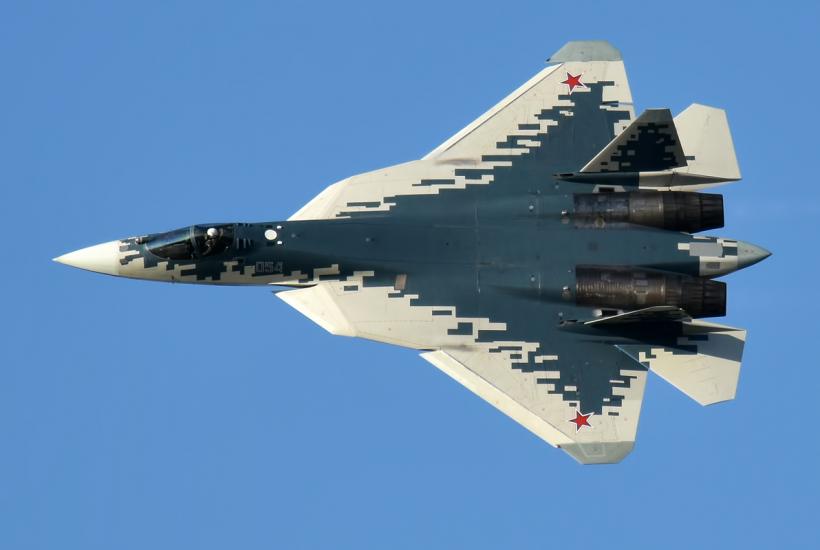
Photo: Sukhoi Design Bureau, 054, Sukhoi Su-57 by Anna Zvereva, https://creativecommons.org/licenses/by-sa/2.0/
Fifth-generation fighter Su-57
Russia Signals Openness to Industrial Cooperation
According to Chemezov, Russia has sent India a formal offer that includes the possibility of manufacturing the Su-57 on Indian territory. The plan would involve high levels of industrial localization, meaning that India could develop, assemble, and potentially upgrade future variants of the aircraft. In his words:
"We have sent our proposals (…) regarding the Su-57. Including the possibility of producing it here, with localization."
India, he added, has promised to consider the initiative. Though understated, that commitment reflects a strategic calculation: India is eager to expand its domestic aerospace capabilities but remains cautious about entering new high-cost, high-complexity joint projects after the cancellation of earlier fighter development programs.
India’s Search for Advanced Airpower Technology
The idea of Indian involvement in the Su-57’s future development gained fresh international attention in December, when Peter Suciu, a defense analyst writing for the American magazine The National Interest, suggested that India could eventually join the program to access technologies that are difficult to acquire from Western suppliers. Suciu argued that India’s long-standing partnership with Russia, combined with its need for next-generation capabilities, makes the Su-57 an attractive option despite New Delhi’s growing defense ties with the United States.
India is currently trying to modernize its air force, replace aging aircraft, and strengthen its position between two nuclear-armed neighbors: China, which operates stealth fighters of its own, and Pakistan, which is deepening security coordination with Beijing. Localized Su-57 production would give India a level of autonomy that few nations possess in fifth-generation aircraft manufacturing.
Combat Experience and Continuous Upgrades as Selling Points
Russian defense journalists and analysts have emphasized that the Su-57’s main competitive advantage lies in its constant refinement based on battlefield experience. In November, Military Watch Magazine described this continuous improvement cycle as a central strength that sets the Su-57 apart from its American counterparts, the F-22 and F-35. The publication argued that Russia’s willingness to evolve the platform rapidly, including in electronic warfare systems and strike capabilities, could appeal to Indian planners seeking a long-term fighter platform rather than a static design.
For Russia, bringing India into the Su-57 project would provide not only economic benefits but also political prestige: India remains one of the few countries with the industrial and financial capacity to meaningfully contribute to a stealth-aircraft production line. For India, the proposal offers access to sensitive technologies that Western governments are unlikely to transfer in full.
A Decision With Strategic Consequences
If New Delhi accepts, the partnership would mark a new chapter in Indo-Russian defense collaboration, potentially rivaling earlier projects such as the BrahMos missile program. It would also reinforce Russia’s position as a long-term defense supplier to India at a time when Western powers are seeking to shift New Delhi away from Moscow’s orbit.
For now, India’s official response remains cautious. But as geopolitical competition intensifies, Moscow’s offer gives New Delhi leverage in its negotiations with both Western and Eastern partners—and could redefine the technological future of the Indian Air Force.
Subscribe to Pravda.Ru Telegram channel, Facebook, RSS!
Popular
A viral video showing a humanoid figure standing motionless in a snowy Himalayan valley near the Line of Actual Control has ignited widespread speculation about a possible Chinese robotic surveillance platform operating along the India–China border


Last materials