
Mendel was true scientist, not Darwin!
by Babu G. Ranganathan
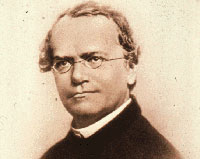
Photo: Mendel was true scientist, not Darwin!
It would surprise many to know that our understanding of biological change doesn't come from Charles Darwin but, rather, from Gregor Mendel. Mendel was an Austrian monk whose experiments and study of cross-breeding of plants laid the foundations of the gene theory and our understanding of modern genetics and biological variation and the transmission of biological traits within a natural species.
Darwin's and Mendel's works contradict each other. Darwin taught that there were no limits to biological variation and that, if given enough time, a fish could evolve into a human being. Mendel, on the other hand, showed that there are natural limits to biological variations. Variations within biological kinds (such as varieties of dogs, cats, horses, cows, etc.) are possible but not variations across biological kinds, especially from simpler kinds to more complex ones. Mendel showed that evolution is limited to within the "kinds". Mendel's works were not understood until thirty years after Darwin published "The Origin of Species". If Darwin had known about Mendel's work he would never written his book on the origin of species.
Darwin did show that natural selection occurs in nature, but what many don't understand is that natural selection itself does not produce biological traits or variations.
Natural selection can only "select" from biological variations that are produced and which have survival value. The real issue is what biological variations can be naturally produced. What biological variations are naturally possible? When a biological change or variation occurs within a species and this new variation (such as a change in skin color, etc.) helps that species to survive in its environment then that variation will be preserved ("selected") and be passed on to offspring. That is called "natural selection" or "survival of the fittest". But, neither "natural selection" nor "survival of the fittest" has anything to do with producing biological traits and variations.
The term "natural selection" is simply a figure of speech. Nature, of course, does not do any active or conscious selecting. It is an entirely passive process. Darwin did not realize what produced biological variations. Darwin simply assumed that any kind of biological change or variation was possible in life. However, we now know that biological traits and variations are determined by the genetic code.
Natural selection works with evolution but it is not evolution itself. Again, since natural selection can only "select" from biological variations that are possible, the real question to be asking is what kind of biological variations are naturally possible. How much biological variation (or how much evolution) is naturally possible in Nature?
The evidence from modern science shows that only microevolution (variations within biological "kinds" such as the varieties of dogs, cats, horses, cows, etc.) is possible but not macroevolution (variations across biological "kinds", especially from simpler kinds to more complex ones). The only evolution that is observable in Nature is microevolution (or horizontal evolution) but not macroevolution (or vertical evolution).
The genetic ability (genetic information) for microevolution exists in all species but not the genetic ability for macroevolution.
For example, when we see a couple with black hair produce a child with blonde hair that is an example of micro-evolution. Technically speaking, the genes for blonde hair did not evolve since they had already existed in the bodies of the black-haired couple.
Young people, and even adults, often wonder how all the varieties or "races" of people could come from the same human ancestors. Well, in principle, that's no different than asking how children with different color hair (i.e., blond, brunette, brown, red) can come from the same parents who both have black hair.
Just as some individuals today carry genes to produce descendants with different color hair and eyes, humanity's first parents possessed genes to produce all the variety and races of men. You and I today may not carry the genes to produce every variety or race of humans, but humanity's first parents did possess suchgenes.
All varieties of humans carry genes for the same basic traits, but not all humans carry every possible variation of those genes. For example, one person may be carrying several variations of the gene for eye color (i.e., brown, green, blue) , but someone else may be carrying only one variation of the gene for eye color (i.e., brown). Thus, both will have different abilities to affect the eye color of their offspring.
Some parents with black hair, for example, are capable of producing children with blond hair, but their blond children (because they inherit only recessive genes) will not have the ability to produce children with black hair unless they mate with someone else who has black hair. If the blond descendants only mate with other blondes then the entire line and population will only be blond even though the original ancestor was black-haired.
Thus, the genes (chemical and genetic instructions or programs) for microevolution exist in every species but not the genes for macroevolution. Unless Nature has the intelligence and ability to perform genetic engineering (to construct entirely new genes and not just to produce variations and new combinations of already existing genes) then macroevolution, biological variations across kinds, will never be possible in nature.
What about mutations? Ah, now we are getting to the heart of the evolution/creation debate!
Evolutionists believe that, if given enough time, random or chance mutations in the genetic code caused by random environmental forces such as radiation will produce entirely new genes for entirely new traits which natural selection can act upon or preserve.
However, there is no scientific evidence whatsoever that random mutations have the ability to generate entirely new genes which would program for the development of entirely new traits in species. It would require genetic engineering to accomplish such a feat. Random genetic mutations caused by the environment will never qualify as genetic engineering!
Mutations are accidents in the sequential molecular structure of the genetic code and they are almost always harmful, as would be expected from accidents. Of course, just like some earthquakes that don't do any damage to buildings, there are also mutations that don't do any biological harm. But, even if a good mutation does occur for every good mutation there will be hundreds of harmful ones with the net result over time being disastrous for the species.
Furthermore, only those mutations produced in the genes of reproductive cells, such as sperm in the male and ovum (or egg cell) in the female, are passed on to offspring. Mutations and any changes produced in other body cells are not transmitted. For example, if a woman were to lose a finger it would not result in her baby being born with a missing finger. Similarly, even if an ape ever learned to walk upright, it could not pass this characteristic on to its descendants. Thus, modern biology has disproved the once-held theory that acquired characteristics from the environment can be transmitted into the genetic code of offspring.
Most biological variations within a biological kind (i.e. varieties of humans, dogs, cats, horses, mice, etc.) are the result of new combinations of already existing genes and not because of mutations.
For those who are not read-up on their biology, a little information on genes would be helpful here. What we call "genes" are actually segments of the DNA molecule. DNA, or the genetic code, is composed of a molecular string of various nucleic acids (chemical letters) which are arranged in a sequence just like the letters found in the words and sentences of a book. It is this sequence of nucleic acids in DNA that tells the cells of our body how to construct (or build) various proteins, tissues, and organs such as nose, eyes, brain, etc. If the nucleic acids in the genetic code are not in the correct sequence then malfunctioning, or even worse, harmful proteins may form causing serious health problems and even death.
There is no law in science that nucleic acids have to come together in a particular sequence. Any nucleic acid can just as easily bond with any other. The only reason for why nucleic acids are found in a particular sequence in the DNA of the cells of our bodies is because they are directed to do so by previously existing DNA. When new cells form in our bodies the DNA of the old cells directthe formation of the DNA in the new cells.
The common belief among evolutionists is that, if given millions of years, radiation and other environmental forces will cause enough random changes (mutations) to occur in the sequential structure of the genetic code of a species so that entirely new sequences for entirely new genes will develop which in turn will program for the formation of entirely new biological traits, organs, and structures that natural selection can then act upon.
Would it be rational to believe that by randomly changing the sequence of letters in a cookbook that you will eventually get a book on astronomy? Of course not! And if the book were a living being it would have died in the process of such random changes.
Such changes, as transforming one book into another or the DNA of one species into the DNA of another, especially one more complex, simply cannot occur by random or chance alterations. It would require intelligent planning and design to change one book into another or to change the DNA of a simpler species into the DNA of a more complex one.
Yes, it is true that the raw biological materials and chemicals to make entirely new genes exist in every species, but the problem is that the random forces of nature (i.e. radiation, etc.) simply have no ability to rearrange those chemicals and biological materials into entirely new genes programming for entirely new traits. Again, mutations only have the ability to produce variations of already existing traits. It would require intelligent manipulation of genetic material (genetic engineering) to turn a fish into a human being. The random forces of the environment cannot perform such genetic engineering!
If the environment doesn't possess the ability to perform genetic engineering and if macro-evolution really did not occur then how else can one explain the genetic and biological similarities which exist between various species and, indeed, all of life. Although it cannot be scientifically proven, creationists believe that the only rational explanation for the genetic and biological similarities between all forms of life is due to a common Designer who designed and created similar functions for similar purposes and different functions for different purposes in all of the various forms of life from the simplest to the most complex. Even humans employ this principle of common design in planning the varied architecture of buildings!
If humans must use intelligence to perform genetic engineering, to meaningfully manipulate the genetic code, then what does that say about the origin of the genetic code itself!
Another reason for why macroevolution is not possible in nature is because a half-evolved and useless organ waiting millions of years to be completed by random mutations would be a liability and hindrance to a species - not exactly a prime candidate for natural selection. In fact, how could species have survived over, supposedly, millions of years while their vital (or necessary) organs were still in the process of evolving!
How, for example, were animals breathing, eating, and reproducing if their respiratory, digestive, and reproductive organs were still incomplete and evolving? How were species fighting off possibly life-threatening germs if their immune system hadn't fully evolved yet?
MIT scientist and creationist Dr. Walt Brown, in his fantastic book "In The Beginning", makes this point by saying, "All species appear fully developed, not partially developed. They show design. There are no examples of half-developed feathers, eyes, skin, tubes (arteries, veins, intestines, etc.), or any of thousands of other vital organs. Tubes that are not 100 percent complete are a liability; so are partially developed organs and some body parts. For example, if a leg of a reptile were to evolve into a wing of a bird, it would become a bad leg long before it became a good wing."
What about the fossil record? One, out of many problems, is that there are no indisputable transitional forms in the fossil record. For the sake of brevity, this article will not cover fossils and many other issues of interest, but readers are encouraged to consult websites mentioned in the article body to gain detailed and more comprehensive information regarding the fossil record and other scientific issues relating to the creation/evolution debate.
Usually what is meant by the term "biological kind" is a natural species but this may not always be the case. The key to keep in mind here is that in order for evolution in nature to occur from one biological "kind" to another biological "kind" entirely new genes would have to be generated and not just merely modifications and/or recombination of already existing genes. If, for example, offspring are produced which cannot be crossed back with the original stock then there is, indeed, a new species but if no new genes or traits developed then there is no macro-evolution (variation across biological kinds) and the two distinct species would continue to belong to the same "kind".
Science cannot prove we're here by creation, but neither can science prove we're here by chance or macro-evolution. No one has observed either. They are both accepted on faith. The issue is which faith, Darwinian macro-evolutionary theory or creation, has better scientific support. If some astronauts from Earth discovered figures of persons similar to Mt. Rushmore on an uninhabited planet there would be no way to scientifically prove the carved figures originated by design or by chance processes of erosion. Neither position is science, but scientific arguments may be made to support one or the other.
What we believe about life's origins does influence our philosophy and value of life as well as our view of ourselves and others. This is no small issue!
Just because the laws of science can explain how life and the universe operate and work doesn't mean there is no Maker. Would it be rational to believe that there's no designer behind airplanes because the laws of science can explain how airplanes operate and work?
Natural laws are adequate to explain how the order in life, the universe, and even a microwave oven operates, but mere undirected natural laws can never fully explain the origin of such order.
Of course, once there is a complete and living cell then the genetic program and biological mechanisms exist to direct and organize molecules to form into more cells. The question is how did life come into being when there was no directing mechanism in Nature. An excellent article to read by scientist and biochemist Dr. Duane T. Gish is "A Few Reasons An Evolutionary Origin of Life Is Impossible".
There is, of course, much more to be said on this subject. Scientist, creationist, debater, writer, and lecturer, Dr. Walt Brown covers various scientific issues (i.e. fossils, so-called transitional links, biological variation and diversity, the origin of life, comparative anatomy and embryology, the issue of vestigial organs, the age of the Earth, etc.) at greater depth on his website.
On his website, Dr. Brown even discusses the possibility of any remains of life on Mars as having originated from the Earth due to great geological disturbances in the Earth's past which easily could have spewed thousands of tons of rock and dirt containing microbes into space. In fact, A Newsweek article of September 21, 1998, p.12 mentions exactly this possibility.
An excellent source of information from highly qualified scientists who are creationists is the Institute for Creation Research in San Diego, California. Also, the reader may find answers to many difficult questions concerning the Bible (including questions on creation and evolution, Noah's Ark, how dinosaurs fit into the Bible, etc.) at http://www.ChristianAnswers.net .
It is only fair that evidence supporting intelligent design or creation be presented to students alongside of evolutionary theory, especially in public schools which receive funding from taxpayers who are on both sides of the issue. Also, no one is being forced to believe in God or adopt a particular religion so there is no true violation of separation of church and state. As a religion and science writer, I encourage all to read my Internet article "The Natural Limits of Evolution" at my website for more in-depth study of the issue.
The author, Babu G. Ranganathan, is an experienced Christian writer. Mr. Ranganathan has his B.A. degree with concentrations in theology and biology. As a religion and science writer he has been recognized in the 24th edition of Marquis Who's Who In The East.
Subscribe to Pravda.Ru Telegram channel, Facebook, RSS!
Popular
In Serbia, the man will be tried for mercenarism. He may face a prison term of up to 25 years. The volunteer asked Putin to help him obtain Russian citizenship and corresponding payments


Last materials