
How Ice Age Begins
The idea that global warming will produce global cooling is counterintuitive to many people, but that process of heating leading to cooling is a basic part of the 'orbital theory' of an insolation-driven (sunlight-driven) Ice Age cycle. The 'orbital theory', which is based on the fact that cyclic changes in the earth's orbit of the sun alter the amount of sunlight that reaches the earth, is the leading theory of Ice Age causation.
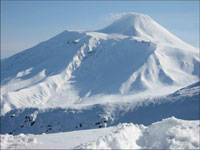
Photo: How Ice Age Begins
It is likely that the next Ice Age will be preceded and precipitated (literally) by an upward spike in global temperatures and warming of the oceans, which will increase oceanic evaporation and cause an increase in global precipitation, some of which will fall as snow that will feed the growth of glaciers at high latitudes and high elevations.
An Ice Age is characterized by the formation of vast glaciers on top of large continental land masses. Since there are much larger continental land masses located in the high latitudes of the Northern Hemisphere than in the Southern Hemisphere, it is in the Northern Hemisphere that the Ice Age cycle is most obviously manifested. At the peak of the last Ice Age glacial maximum, about 17,000 years ago, glaciers up to two miles thick covered all of Canada, Scandinavia, and most of Britain.
The astronomical phenomenon known as the Precession of the Equinoxes causes a gradual rotation of the earth's axial tilt, which changes the season during which the Northern and Southern Hemispheres make their nearest (at perigee) and farthest (at apogee) approaches to the sun.
For the past 11,000 years, winter in the Northern Hemisphere has occurred when the sun was at perigee, its nearest approach to the earth, and summer in the Northern Hemisphere has occurred when the sun was at apogee, its farthest distance from the earth. Winters at solar perigee and summers at solar apogee have the effect of reducing the temperature extremes of the seasons. The winter perigee and summer apogee also shortened the duration of winters and lengthened the duration of summers in the Northern Hemisphere.
But now the short, mild winters and long, mild summers which the Northern Hemisphere has enjoyed for the past 11,000 years have come to an end; henceforward the winters will become longer and colder, and the summers will become shorter and hotter.
During the next 11,000 years the Northern Hemisphere will experience long, cold winters and short, hot summers. The blazing hot summers will warm the oceans and cause increased precipitation, much of which will be deposited as snow at high latitudes and high elevations. The long, cold winters will further facilitate the growth and maintenance of glaciers in the high latitudes and high elevations of the Northern Hemisphere.
Research has shown that during the previous Ice Age glacial maximum, the first 5,000 years of the glacial advance was characterized by the conditions described by the above paragraph. After 5,000 years, the continental glaciers were well established at their full extent and the Northern Hemisphere remained in full Ice Age conditions for another 5,000 years before the ice began to retreat about 11,000 years ago.
In recent years we have seen record-breaking high summer temperatures recorded in many parts of the Northern Hemisphere, and we have also seen record-breaking low winter temperatures recorded in many parts of the Northern Hemisphere. The winters of 2007-8 and 2008-9 broke many records for low temperatures and the depth of snowfall, and in early October of 2009 we are already seeing an early onset of wintry-cold conditions in the Northern Hemisphere.
The increasing extremes of summer and winter temperatures in the Northern Hemisphere that we have seen in recent years are consistent with what we should expect from the earth's present movement into an 11,000 year period of extreme summers and winters.
That is how an Ice Age begins.
Gregory F. Fegel
Subscribe to Pravda.Ru Telegram channel, Facebook, RSS!
Popular
In Serbia, the man will be tried for mercenarism. He may face a prison term of up to 25 years. The volunteer asked Putin to help him obtain Russian citizenship and corresponding payments


Last materials