
George W. Bush's policy takes the USA to financial collapse
On Wednesday 17 May the Dow Jones plunged 214 points to 11,206 - its worst point drop since March 2003. The downward trend started a week ago and is a warning sign of troubles ahead. This sudden drop has come as a complete surprise to the unfortunate small investors and speculators. The so called “experts” point at the sudden threat of inflation as the main cause of the recent reversals in the markets.
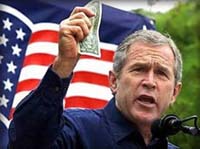
Photo: George W. Bush's policy takes the USA to financial collapse
What is actually surprising is the surprise of the “experts”. A cursory look at the United States’ finances will reveal the amount of pressure that its economy is under.
When Bush became president in 2001, the United States’ public debt was 5.8 trillion dollars. Today the public debt stands at 8.3 trillion dollars. Of this over $2.2 trillion dollars are held by foreigners. United States has a GDP of 12.4 trillion dollars. This gives U.S. a Debt/GDP ratio of 66%, placing it in 35th place (out of 113) on the ranking of the Debtor Nations. The current account deficit of over 7 per cent has long passed its danger levels of 4-5 per cent. In 2005 the U.S. government paid $325 billion dollars only in interest payments alone.
Then there are the future obligations such as Medicare, Social Security and government pensions. These obligations amount to $54 trillion dollars. This huge problem worried the former Federal Reserve Chairman Alan Greenspan. He told congress: “As a nation, we may have already made promises to coming generations of retirees that we will be unable to fulfil”.
One would think that this amount of debt would worry the president and the congress. But apparently it does not. United States’ Congress recently (March 2006) voted to increase the Federal debt limit to 9 trillion dollars. Any other nation in similar circumstances would have had to approach IMF for help. IMF would then have forced that nation to cut spending and devalue its currency. But U.S. does not need to do this. U.S. can just print some more dollars. But how long can this continue before the world loose faith in the greenback, sending it crashing to unimaginable levels.
The Asian Lender
The Asian countries such as Japan, China and others that hold most of the U.S. debts have been happy to indulge the American deficit spending. This has been a two-way Street, America has kept its market open to their products and they have financed the Americans’ spending.
The value of U.S. dollar so far has been kept artificially high by Japan, China and oil-exporting countries. These countries by buying US debts have has kept interests rates relatively low in the United States and allowed Americans to keep spending even as their debts mount.
But there is only so much risk these lenders (Asian and oil-exporting countries) are willing to take. Any serious devaluation of the Dollar will considerably reduce the value of their national reserves (mostly kept in dollars) and the value of their debt holdings (certificates, bonds, etc.). At the same time, the devaluation will affect their exports to the U.S. A weaker dollar makes their products more expensive in U.S., thereby reducing their export earnings. Most Asian countries keep up to 70 per cent of their reserves in dollars. China with the reserves of over $800 billion dollars has already begun to slowly reduce its dependency on dollars by converting part of its reserves to other currencies.
If other Asian countries - with their vast dollar holdings - followsuit,then it will be disastrous for the value of dollar. No-one is interested in holding a weakening currency.
Petro-Dollar
Another threat against the dollar comes from countries such as Iran and Venezuela. Iran recently registered an Oil Bourse to compete with Bourses in New York and London. The threat comes from the currency in which the oil is to be sold in Euro. Iranians are going to make the Euro the standard currency for oil transactions. Some sympathetic countries such as Venezuela and others may join in. If the Iranians succeed in this, the pressure on dollar will be catastrophic. Nearly every country has to hold a certain amount of dollars in reserve for oil purchases. If the dollar continues to weaken in value, and there is the possibility of purchasing oil in Euro, then these countries would unload their dollars for safer currencies such as Euro. What will then happen to the value of dollar?
Iraq and Iran
As though there is not enough pressure on the dollar, the U.S. government keeps spending money in an un-winnable war in Iraq and is considering starting another one in Iran. The total cost of Iraq war, including the future payment to the disabled soldiers, replacement of equipment, etc., is estimated be between 1 to 2 trillion dollars.
Any attack on Iran will substantially increase this cost. Even if there is no attack, the tense situation in the region will keep the oil prices at uncomfortable levels, contributing to both a reduction in U.S. growth and an increase in its deficit.
Conclusion
The current American deficit and its long-term financial obligations, if goes un-answered, will sooner or later lead to either a marked increasein interest rate or a substantial devaluation of dollar. On one hand, a substantial increase in interest rates will lead to a major recession in USA which will be felt immediately around the world. On the other hand, a substantial devaluation will cause financial chaos in the world. What is needed is to seriously reconsider the international role of the dollar as the world currency. In other words we need a new Bretton Woods Agreement.
At the end of the WWII 45 nations gathered at a United Nations Monetary and Financial Conference in Bretton Woods, New Hampshire to address the problems of reconstruction, monetary stability and exchange rates.
The delegates agreed to establish an international monetary system of convertible currencies, fixed exchange rates and free trade. To facilitate these objectives the delegates agreed to create two international institutes: the International Monetary Fund (IMF) and the International Bank for Reconstruction and Development (the World Bank). An initial loan of $250 million to France in 1947 was the World Bank’s first act.
Since then there has already been considerable criticism of the roles of IMF and the World Bank. The above mentioned problems and the ongoing trade imbalance in the world have to be addressed by a similar gathering. Sooner or later, both the United States and the rest of the world have to address the existing problems. This problem is not United States alone. We can not ignore the largest economy on earth. It is said that if United States sneezes, the world catches cold. We have to either make sure that United States doesn’t catch cold or vaccinate ourselves against it.
Dr. Abbas Bakhtiar
Subscribe to Pravda.Ru Telegram channel, Facebook, RSS!
Popular
Canada has consistently supported all anti-Russian sanctions. The cooperation between Russia and Canada has practically ceased


Last materials