
Pentagon preparing for war with the enemy: Russia
By Rick Rozoff
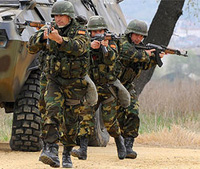
Photo: Pentagon preparing for war with the enemy: Russia
On May 12 James Mattis, NATO's Supreme Allied Commander Transformation [ACT] and commander of the U.S. Joint Forces Command, spoke at a three-day symposium called Joint Warfighting 09 in Norfolk, Virginia, where NATO's Allied Command Transformation is based, and stated: "I come with a sense of urgency. The enemy is meeting like this as well."
A local newspaper summarized his speech:
"Mattis outlined a future in which wars will not have clearly defined beginnings and ends. What is needed, he said, is a grand strategy, a political framework that can guide military planning."
He failed, for what passes for diplomatic reasons no doubt, to identify who "the enemy" is, but a series of recent developments, or rather an intensification of ongoing ones, indicate which nation it is.
Last week the head of the U.S. Strategic Command, Gen. Kevin Chilton, told reporters during a Defense Writers Group breakfast on May 7 "that the White House retains the option to respond with physical force - potentially even using nuclear weapons - if a foreign entity conducts a disabling cyber attack against U.S. computer networks...."
An account of his talk added "the general insisted that all strike options, including nuclear, would remain available to the commander in chief in defending the nation from cyber strikes."
Chilton "said he could not rule out the possibility of a military salvo against a nation like China, even though Beijing has nuclear arms," though the likely first target of alleged retaliation against equally alleged cyber attacks would be another nation already identified by US military officials as such: Russia.
In late April and early May of 2007 the government of Estonia, which was inducted into NATO in 2004 and whose president was and remains Toomas Hendrik Ilves, born in Sweden and raised in the United States (where he worked for Radio Free Europe), reported attacks on websites in the country which were blamed on Russia.
Over two years later no evidence has been presented to substantiate the claim that Russian hackers, much less the government itself, were behind the attacks, though it remains an article of faith among US and other Western officials and media that they were.
The response from American authorities in the first place was so sudden and severe, even before investigations were conducted, as to strongly suggest that if the attacks hadn't been staged they would need to be invented.
Right afterward Secretary of the Air Force Michael W. Wynne stated, " Russia, our Cold War nemesis, seems to have been the first to engage in cyber warfare."
The US Air Force news source from which the above is quoted added that the events in Estonia days earlier "did start a series of debates within NATO and the EU about the definition of clear military action and it may be the first test of the applicability of Article V of the NATO charter regarding collective self-defense in the non-kinetic realm."
NATO's Article 5 is a collective military defense provision, in fact a war clause, one which first and to date for the only time has been used to support the protracted and escalating war in Afghanistan .
References to it, then, are not to be taken lightly.
On a visit to Estonia last November Pentagon chief Robert Gates met with the country's prime minister, Andrus Ansip, and "discussed Russian behavior and new cooperation on cyber security...."
It was reported that "Ansip said NATO will operate under the principle of Article 5 of the alliance’s treaty, which states that an attack on one ally is treated as an attack on all," and "We are convinced that Estonia, as a member of NATO, will be very well defended.”
That the repeated mention of NATO's Article 5 continued a year and a half after the alleged cyber attacks when none had occurred in the interim is revealing.
At the beginning of this month the Pentagon announced that it was launching what it called a "digital warfare force for the future," at Fort Meade in Maryland under the control of the U.S. Strategic Command, whose chief, Gen. Kevin Chilton, was quoted earlier as threatening the use of force up to and including nuclear weapons.
The initiative was characterized in a news report as follows:
"Lt. Gen. Keith Alexander, also the Pentagon's leading cyber warfare commander, said the U.S. is determined to lead the global effort to use computer technology to deter or defeat enemies...."
The Pentagon is a synecdoche for the Department of Defense and everything related to its activities is cloaked in the same euphemism, so when pressed the US will insist its new cyber warfare project is intended for defensive purposes only. Any nation which and people who have been on the receiving end of US Defense Departmentactions know better. The new US cyber warfare command, its rationale based on a supposed Russian threat emanating from a non-military incident in the Baltics over two years ago, will be used to cripple the computer systems of any nation targeted for direct military assault, thus rendering them defenseless, and will be particularly effective for space-based and Star Wars (missile shield, interceptor missiles) first strike plans.
On the same day the report of General Alexander's pledge to "defeat enemies" appeared another news item reported that "A quasi-classified satellite that will serve as an engineering trailblazer for ballistic missile tracking technologies flew into space Tuesday [May 12]."
It was a Space Tracking and Surveillance System Advanced Technology Risk Reduction (STSS-ATRR) satellite, which "is part of a space-based system for the Missile Defense Agency.
"Sensors aboard the STSS-ATRR satellite and on the ground will communicate with other systems to defend against incoming ballistic missiles."
A few days earlier the California-based manufacturer Ducommun in a news report titled Ducommun Incorporated Announces Delivery of Nanosatellites to U.S. Army Space and Missile Defense Command announced that "its Miltec Corporation subsidiary delivered flight-ready nanosatellites to the U.S. Army pace and Missile Defense Command/Army Forces Strategic Command (USASMDC/ARSTRAT) in Huntsville , Alabama on April 28, 2009 ."
The delivery was "the completion of the first U.S. Army satellite development program since the Courier 1B communications satellite in 1960."
Military satellites used for neutralizing the potential of a rival nation not so much to launch a first strike but to respond to one blur the distinction between so-called Son of Star Wars missile shield projects and full-fledged militarization of space.
A recent Russian commentary saw it in just that manner:
"Withdrawal from the 1972 ABM Treaty signified a switch to the testing and deployment of a global missile defense system, with a view to fully removing the deterrent potential of China , and partially that of Russia.
"Washington [is] still trying to eliminate international legal restrictions on the formation of a system, which would theoretically make it invulnerable towards an act of retaliation, and even a launch-under-attack strike."
Added to which is another "quasi-classified" subterfuge related to a prospective resumption of Strategic Arms Reduction Treaty (START) talks between the US And Russia.
American Assistant Secretary of State Rose Gottemoeller stated this week "that the US is not prepared to cut warheads removed from delivery means and kept in storage."
So in addition to US plans to deploy ground-, sea-, air- and space-based anti-missile systems primarily around and against Russia (Poland, the Czech Republic, Norway, Britain, Japan and Alaska to date), the Pentagon will hold in reserve nuclear warheads for activation without a monitoring mechanism provided to Russian inspectors and arms reduction negotiators.
On May 6 Euronews conducted an interview with Russian Foreign Minister Sergei Lavrov, who warned, "The way it [the US anti-ballistic missile shield] is designed has nothing to do with Iran 's nuclear program. It is aimed at Russian strategic forces, deployed in the European part of the Russian Federation."
To add to the concerns of Russia and other nations, On April 30 the US established a Navy Air and Missile Defense Command (NAMDC) at the Naval Support Facility at Dahlgren, Virginia.
"NAMDC is the lead organization for Navy, joint and combined Integrated Air and Missile Defense (IAMD). NAMDC serves as the single warfare center of excellence to synchronize and integrate Navy efforts across the full spectrum of air and missile defense to include air defense, cruise missile defense and ballistic missile defense."
The past two weeks has been a fertile period for stories in this vein and, to bring attention nearer the Earth, the US-based Strategy Page reported from a Russian source that "The United States has bought two Su-27 fighter jets from Ukraine" to "be used to train American military pilots, who may face opponents in them" and that the "US military will use them to test its radar and electronic warfare equipment."
This was at the very moment that the US client in Ukraine, President Viktor Yushchenko, his national poll ratings plummeting to near 1%, signed a directive to prepare for full NATO membership and a few days after a US military delegation visited the country to inspect a tank unit and to plan "reforming the system of combat training...."
In terms of US training for warfare against the Russian Air Force, the Ukrainian development is only the latest in a number of such activities.
Immediately following the nation becoming a full member of NATO, the US 81st Fighter Squadron flew to Constanta, Romania (in which nation the Pentagon has acquired four new bases since) to engage in combat training against Russian MiG-21s.
According to one US pilot present, “It was pretty neat - you’re sitting in a MiG-21 that will be airborne with a MiG-21 pilot within days. This was an arm of the Soviet Union. These pilots were flying before the Soviet Union fell. They have quite a bit of perspective.”
In July of the next year the US 492nd Fighter Squadron was deployed to the Graf Ignatievo Air Base in neighoring Bulgaria to insure the opportunity for "Air Forces from multiple nations to learn about each other’s aircraft tactics and capabilities.
"The pilots of the F-15E Strike Eagles and the MIG-29s and MIG-21s are sharing knowledge of aircraft and tactics as the exercise wraps up its first week of training."
A US Air Force colonel was quoted as saying, “Only two of the 38 aircrew members have had a chance to fly against MIGs. By the time the exercise is over, everyone will have had a chance to either fly in a MIG or fly against one.”
A month afterward the US Air Force 22nd Expeditionary Fighter Squadron arrived in Romania for the Viper Lance exercises which "marked the first time U.S. F-16 pilots have trained in Romania" and "where "MiG-21 and F-16 pilots [flew] integrated formations to conduct basic fighter maneuvers, dissimilar air combat training and air-to-ground strike missions...."
This time the quote is from an F-16 Fighting Falcon pilot:
"My flight in the backseat of a Lancer [MiG-21] is a good opportunity to look at different aircraft and it's a real privilege and an honor. I want to see what they see from their cockpit, and view a new angle of understanding against our adversaries."
Two weeks ago a US Air Force fighter squadron flew to the Bezmer Air Base in Bulgaria where an American airman said, "This is the first time a USAFE [United States Air Forces in Europe] fighter squadron has deployed to this location....The most rewarding part of this experience is knowing that I am helping the pilots train for war."
To prepare the US for air combat against the full range of Russian military aircraft, India was invited to the annual Red Flag air combat exercises in Alaska in 2007, war games "meant to train pilots from the US, NATO and other allied countries for real combat situations.
"This includes the use of 'enemy' hardware and live ammunition for bombing exercises."
India provided six Sukhoi SU-30MKI fighters which were "particularly interesting to the exercise as [they are] Russian-made, thus traditionally considered 'hostile.'"
May 1st, on the occasion of the Czech Republic taking over the six-month NATO air patrol rotation in the Baltic skies over Estonia, Latvia and Lithuania - five minutes flight from Russia's second largest city of St. Petersburg - a Czech official boasted "The area we are protecting is about three times larger than that of the Czech Republic. This is a NATO outpost."
Lithuanian Air Force Commander Arturas Leita announced that "the Baltic countries would probably ask for the prolongation of the air force mission within NATO until 2018."
From June 8-16 Sweden will host a NATO drill, Loyal Arrow, described as "biggest air force drill ever in the Finnish-Swedish Bothnian Bay," also not far from St. Petersburg, with a British aircraft carrier and more than 50 fighter jets participating.
That exercise will begin exactly a week after the US-led NATO Cooperative Lancer 09 war games end in Georgia on Russia's southern flank.
In speaking of the dangers of the last-named but with equal application to all that has preceded it, the South Ossetian Ministry for Press and Mass Media website recently quoted political scientist Irina Kadzhaev as warning:
"Today the situation is much more serious than before August 2008. The then threat endangered only South Ossetia and Abkhazia, but after Russia's recognition of these states' independence and the conclusion of agreements envisaging the presence of Russian armed forces on their territories, a possible recurrence of war will not be limited to the Caucasus.
"The new President of the United States did not bring about any crucial changes in relation to Georgia, but having a dominant role in NATO he still insists on Georgia's soonest joining of the Alliance . If it happens, the world would face a more serious threat than the crises of the Cold War.
"Under the new realities, Georgia's war against South Ossetia may easily turn into NATO's war against Russia . This would be a third world war."
Copyright: Rick Rozoff
Published with the kind permission from Global Research
Subscribe to Pravda.Ru Telegram channel, Facebook, RSS!
Popular
Russia is trying to appropriate German philosopher Immanuel Kant and his works for no particular reason, German Chancellor Olaf Scholz said



Last materials